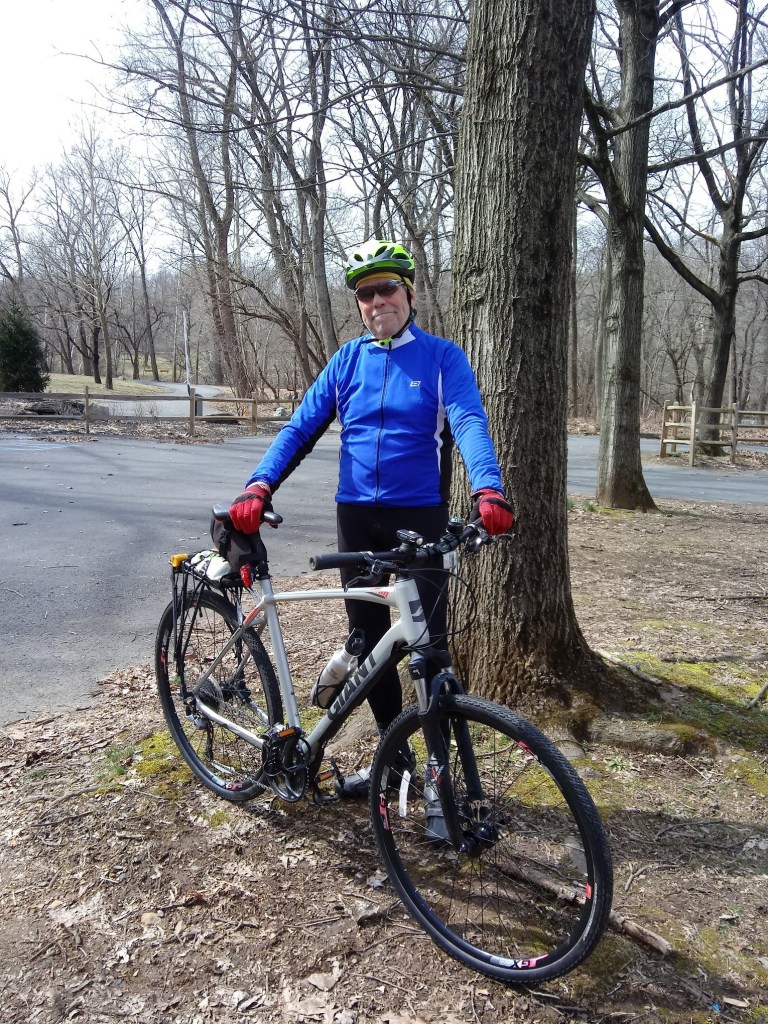
Of course I’ve had a bicycle since I was 12 years old, but biking became a more serious avocation for me late in the 20th century. About that time, a college friend, Dennis Berry, with whom I’d reconnected and who was a serious cyclist, suggested the two of us ride across the U.S. when we turned 60. That would have been 2006. No way I could have done that when the idea was first floated, but thinking it might happen, however unlikely, I started riding seriously myself. I wasn’t climbing mountains or jumping bolders; just riding, mostly, nearby trails. Dennis and I never did make that ride. For one thing, not only was I teaching full-time, but I had year-round administrative responsibilities that kept me busy summers. So I would have had to take a sabbatical to have six weeks free for a cross-country jaunt. Wasn’t going to happen. But it really didn’t matter because I became a trail-riding junkie, starting about 2004.
My bikes
Living in Tidewater, Virginia, in the early 70s, I bought my first good bike. It was a Coventry Eagle, a brand made by the English manufacturer Raleigh. It was a road bike, yellow. Pretty cool. (Too bad I have no photographic record of it.) I was able to ride it out to the Portsmouth campus of Tidewater Community College, just a mile or two from where I was living. That campus sprawled over many rural acres and, as I recall, there were trails. In 1974, I moved to Baton Rouge, Louisiana, and met a couple of fellow grad students who liked to race (sort of) along the River Road just west of the LSU campus. I would join them sometimes, although they did make fun of my no-name bike. I also used the bike to commute to campus from my apartment. I did have a car, but gas was expensive and I had very little money. So that worked out.
Ater grad school, that bike moved with me to teaching jobs in Nebraska and Pennsylvania, by which time it was ten years old and showing some wear. Neighbors tipped my wife and I to a local place that assembled bikes and sold them cheap. Each of us bought one; mine was a mountain bike. I did use it occasionally to commute the couple of miles to my workplace, and I took a few trail rides on it but nothing really serious. I’m thinking I had that bike for eight to ten years. Again, no photographic evidence. (As an aside, this was before cell phones came into vogue — or at least before I had a cell phone myself. So no pix.)
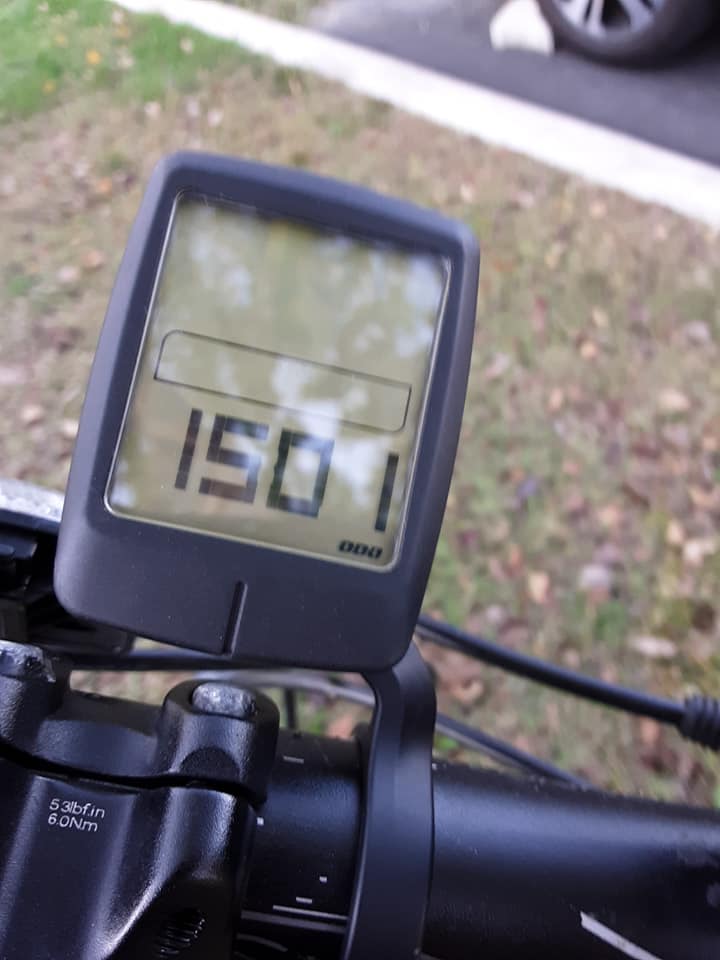
For a Christmas gift in 2002 or ’03, my wife gave me a gift certificate for what was at the time the premier bike shop in our area. I bought a really nice Cannondale hybrid mountain bike from that shop. It seems like a different lifetime now, but I would rack up 2000 miles or more each year, riding from March/April to November, three or four times a week. I think I topped out at 3350 miles one year. This photo of my odomoter is from 2020, the last year that I cracked 1000 miles.
I also made the camping/cyling adventures I have written about and posted elsewhere on this site. And after 2008, when I got into multi-modal composition, I made lots of videos of my biking. So there are pictures.
Here is my Cannondale, pictured during my trip to the Midwest in July 2014. By that time, it had thousands of miles on it and some of it was held together by duct tape!
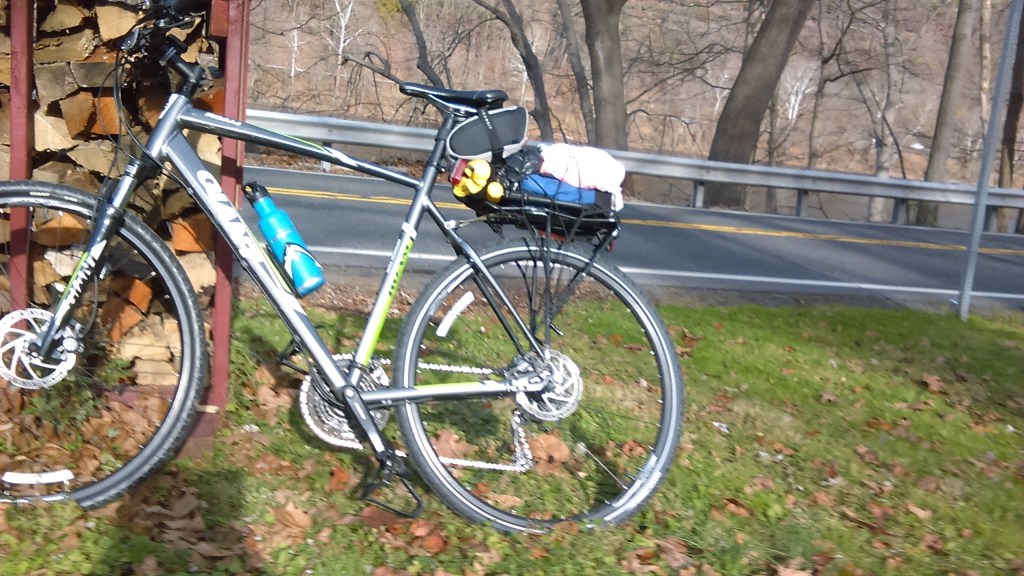
Come spring of 2015, I took this bike to a local bike shop for its annual preseason tune up. Dude told me I might as well buy a new bike, for what it was going to cost me to get the Cannondale ride-ready. Not what I wanted to hear! The shop where I’d bought it was, I thought, a little snobby, but I wanted another Cannondale; it was the best bike I’d ever owned, and I had ridden thousands of miles on it — without taking it cross-country on roads. A web search showed me of another bike shop in a nearby town that offered Cannondales. To it I went — and wound up buying this Giant Roam, another kind of hybrid mountain-road bike. The guy at the shop told me Cannondale no long made a bike like mine, and this Giant was the closest thing to it I could get. This bike had 28-inch wheels, vs. the 26-inchers on the Cannondale, so the frame was bigger too. It had 27 speeds, as opposed to the 18 on the Cannondale. It also had disc brakes, new to me but really efficient. And the overall look of it was sharp, making my old Cannondale “Comfort 400” model look stodgy. So as of the 2015 season, I was rocking and rolling on this Giant “Roam 2.”
In July 2016, I drove up to Maine to hang out with my oldest brother. I was not planning to ride, so I left my bike for maintenance at the shop where I’d bought it. I did bring my tent and camping gear along, and planned to spend one night each in the White Mountains of New Hampshire and the Catskills of New York. A thunderstorm came down on me at my N.H. campsite. I stayed dry enough, but my tent and ground cloth got pretty muddy. I decided to find a motel for the next night, and save the Catskills camping for another day. When I got back home, I had to spread my gear out in the backyard to wash it down and dry it. At the same time, we had a home security technician at the house upgrading our alarm system. Thinking everything was secure while he was working (and my wife was at work at her job) I went out on an errand. While I was gone, the security guy stole my bike, right out of my garage! Jerk! Of course I did not suspect him; thought some pedestrian passing the house had seen it in the garage and snatched it. But about a month later, my wife saw the security guy at a Wawa store and approached him. She said, “You know, it’s funny, but when you were working at our house my husband’s bike was taken from our garage.” His reply fingered him: “Well, I never could have got it into my work van.” Maybe he didn’t; maybe he did. Or maybe he called a friend who had a less crowded van and they stole it together. Whatever the case, I was now almost bikeless. Almost, because I still had the old Cannondale, which I was using on our annual beach vacation. (I had taken the new Giant one time, and got sand in the brakes, making them shriek like a banshee when I put them on.) At this point, my old Cannondale was held together by chewing gum and duct tape, but for two weeks at the beach it was good enough.
Nevertheless, I hustled down to the shop where I bought my Giant, wanting a replacement right away. Nothing in stock, I was told; between model years. I ordered a new Giant Roam, but wouldn’t get it for about six weeks. So I brought my Cannondale in — in such bad shape, I had been told, that it would cost a lot to make it rideworthy — and they fixed it up for, like, $75. I rode it until the new Giant came in.
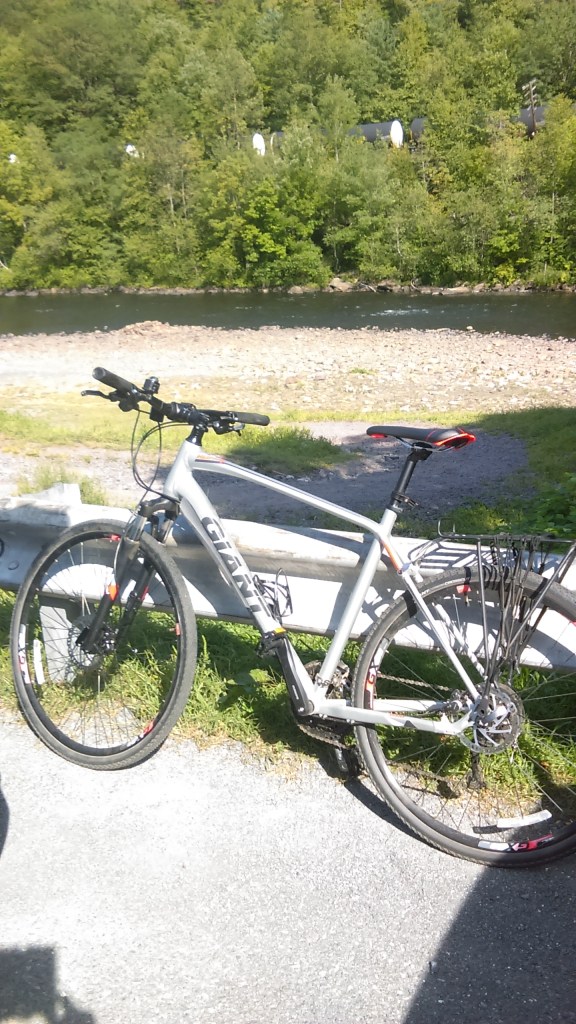
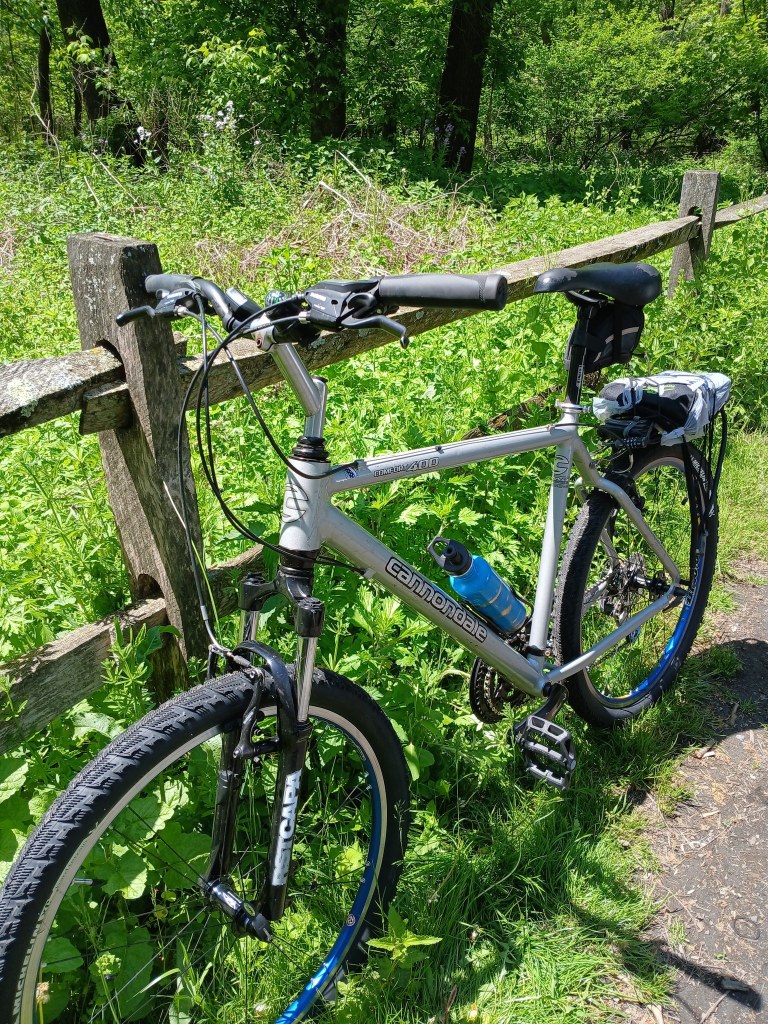
I rode that bike from 2016 to 2023, logging thousands of miles. It was great. Except that my body was shrinking at the time. The hormone therapy I was taking for my prostate cancer caused, among other side-effects, the slow weakening of my bones, particularly in my spine. Collapsing vertebrae cost me at least 4 inches of height! Galling, inasmuch as I had thought of myself as “tall” since I was 17. It also weakened my back. The way I had been storing whatever bike I had was to hang it upside down by the wheels on hooks attached to the roof of my garage. To store it, I had to do a kind of “clean-and-jerk” maneuver with the bike: first lifting and turning it so the wheels would be up, then heaving it overhead and catching the wheels on the hooks. This had been hard enough whenever I came back from a ride, but as of 2021 I had serious trouble making this maneuver. If I did clean-and-jerk it OK, I would have trouble holding the bike steady overhead to get the wheels on the hooks. One time, I lost my balance and fell backwards on the concrete garage floor with the 30-something-pound bike on my chest. More spinal injuries, though nothing so badly broken that I was crippled. But this arrangement simply had no future. (Maybe I should add that we have a single-car garage, so if I want the bike sheltered from the elements and want to store a car in the garage, the only place for it is hanging from the ceiling.) I struggled throughout the 2022 and 2023 seasons. Getting ready for ’24, I made an appointment with my mechanic — to have both the Giant and the Cannondale tuned up for the season. He sensibly asked me if I was uncertain about riding the Giant why I wanted to put the money into a tune-up. Good point. So I sold it and have been riding the past two seasons exclusively on my old Cannondale. The “old” part of it now is the frame; everything else is new: gearing and braking systems, handlebar, pedals, wheels. It still has “Comfort 400” stenciled on the top tube, but it no longer has some of the “comfort” features, namely the shocks under the saddle and on the rear wheel and the wide, padded saddle. But it is still a great bike, maybe even better than it was when I bought it. Here it is, from the summer of 2025.
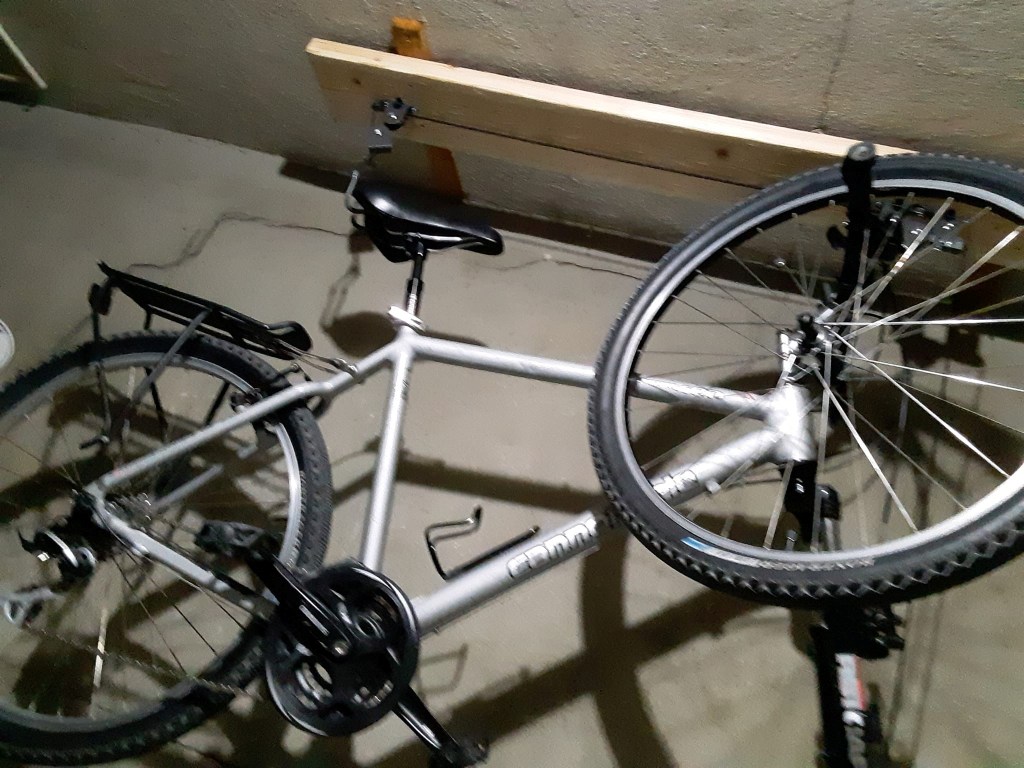
I also bought a storage system that works by pulleys. No more clean-and-jerk; no more staggering with a 37-pound standing shoulder press.
Trails
I prefer trails: no vehicular traffic, mostly level, and usually out in nature somewhere. Even if the mythical cross-country ride was to be done on highways, once I moved from a road bike to a mountain bike, I did my practicing on trails. Before I started riding religiously, I didn’t know there were so many great trails near my house in Bethlehem, PA (where “near” means within an hour’s drive). In this section, I’ll briefly discuss some trails near where I live and include links to their websites.
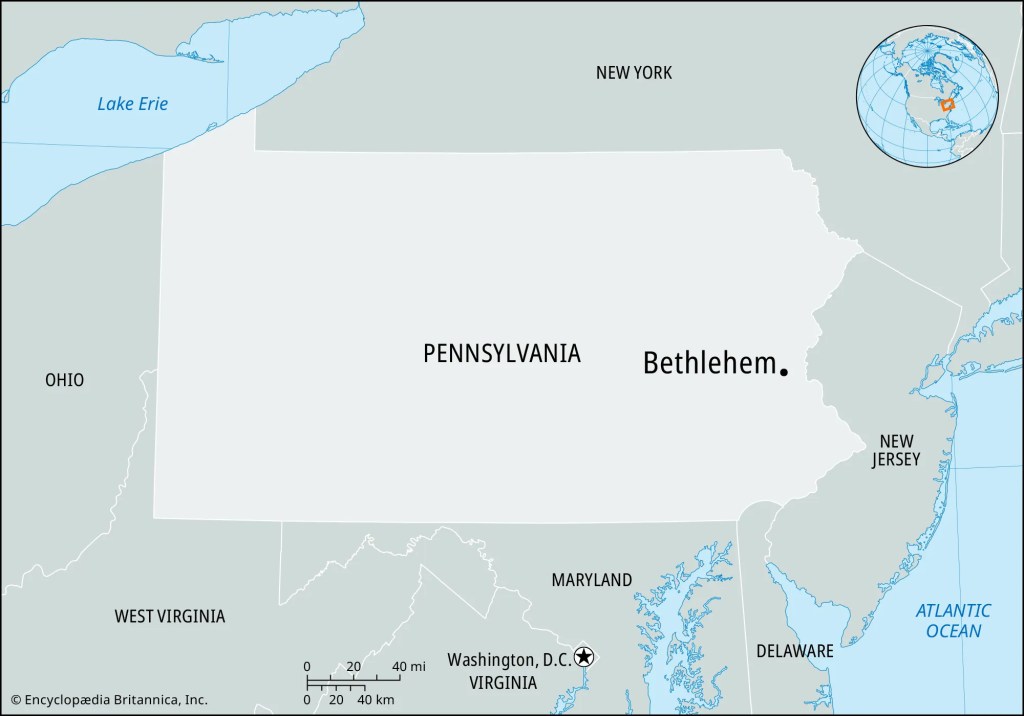
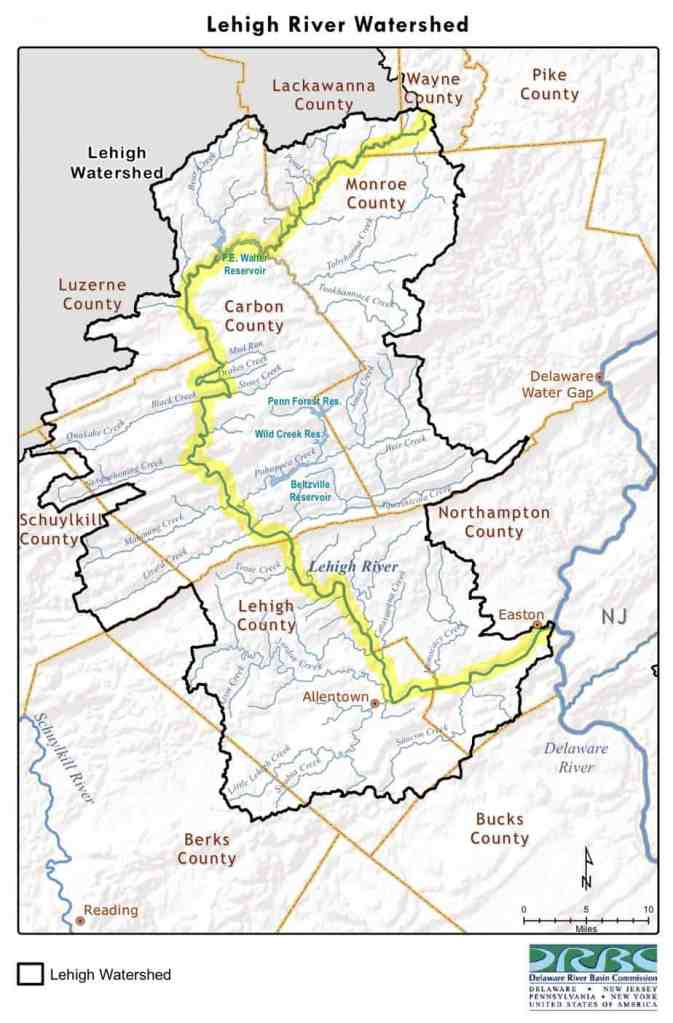
Bethlehem is in the Lehigh Valley, so named because the Lehigh River is the dominant geographical feature. The Lehigh rises in the Poconos in northeast Pennsylvania and flows 109 miles to where it empties into the Delaware River at Easton, 12 miles east of Bethlehem.
The D&L Trail —
In the early 19th century, canals were dug along the Lehigh upriver from Easton and along the Delaware upriver from Philadelphia. That part of the Delaware and all of the Lehigh are too shallow for big boat traffic, so canals were the way to, basically, send coal from the Poconos to Philadelphia and manufactured goods from Philly up to the Poconos. The canal towpaths where mules once pulled the boats have been repurposed as recreational trails. They connect to rails-to-trails upriver from the town of Jim Thorpe in the southern Poconos, making altogether the 165-mile-long Delaware and Lehigh Trail, from Bristol, Bucks Co., to Wilkes-Barre, Luzerne Co.
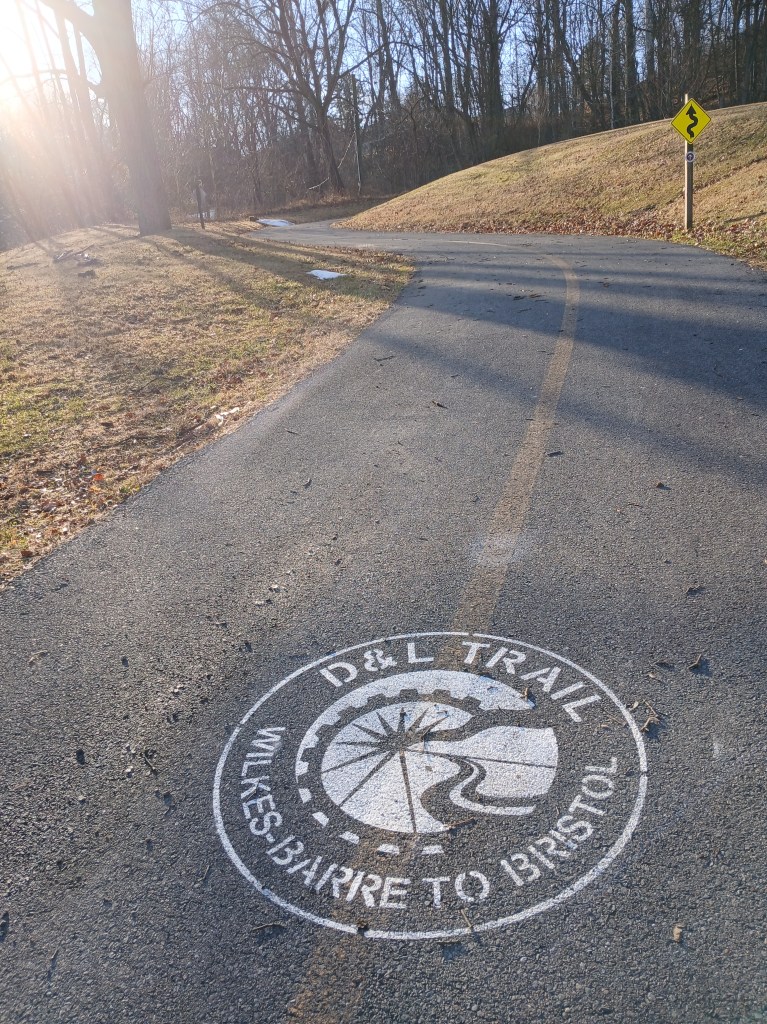
As the Lehigh River flows through Bethelehem, the trail runs beside it. I’ve not ridden the length of the D&L, but I have ridden much of it at various times from Lumberville, Bucks Co., along the Delaware (mile marker 31), to past White Haven, Luzerne Co. (mile marker 140), along the Lehigh.
Two or three miles north of White Haven, the trail diverges from the Lehigh and becomes, for me, scenically less interesting. So I have covered about 100 miles of the D&L. Because the trail is so long, segments of it are known by local names: “The Lehigh Canal,” “The Delaware Canal,” “The Lehigh Gorge,” etc.
The portion of the trail that runs from Weissport, Carbon Co., northwards to White Haven, Luzerne Co., offers the most dramatic scenery: the Lehigh Gorge. A few years ago, a bridge was erected across the Lehigh River at Jim Thorpe that effective lengthened the available rides through the woodsiest parts. The town of Jim Thorpe is often crowded on weekends and in summer, but before the contruction of the bridge, if I wanted to ride through the Gorge, I’d have to start in Jim Thorpe itself or in the state park at Glen Onoko, which is about five miles upriver.
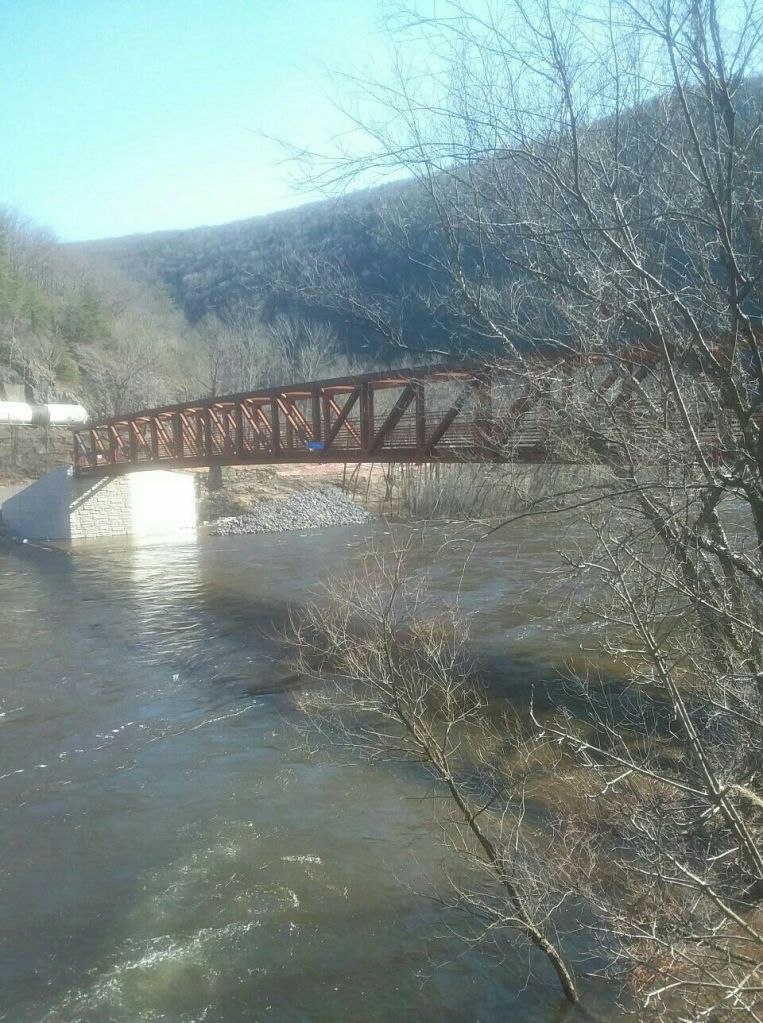
With the bridge in place, I can ride into the Gorge from virtually anywhere below it. One trailhead is in Weissport, a dinky town near the hicktown of Lehighton. That stretch of trail has been upgraded from Weissport to the bridge at Jim Thorpe and it affords some stunning views of the cliffs and the river. The D&L Trail runs along the west bank of the Lehigh River from Cementon up to Lehighton; to continue on the trail, it is necessary to ride to the east bank on a road bridge (although with designated bike lanes) and through the center of Weissport. Here’s that town bragging on its dominant culture one summer afternoon:
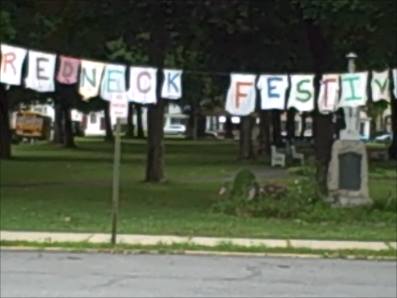
Weissport offers nothing else except a trailhead less busy than Glen Onoko or Jim Thorpe.
The “Cement Belt Trail” —
But there are some other nearby rails-to-trails with which I am familiar. Among them is the short (six miles one-way) Nor-Bath Trail (so named because its terminal points are near the boroughs of Northampton on the west and Bath on the east). From Northampton, it is possible to connect to the D&L on the west bank of the Lehigh River and ride north … a long way; it is also possible to connect with the Ironton Rail Trail, which runs away from the river to the west, connecting Northampton with the little place called Ironton.
https://norcoparks.recdesk.com/Community/Facility/Detail?facilityId=18
https://www.irontonrailtrail.org/map.html
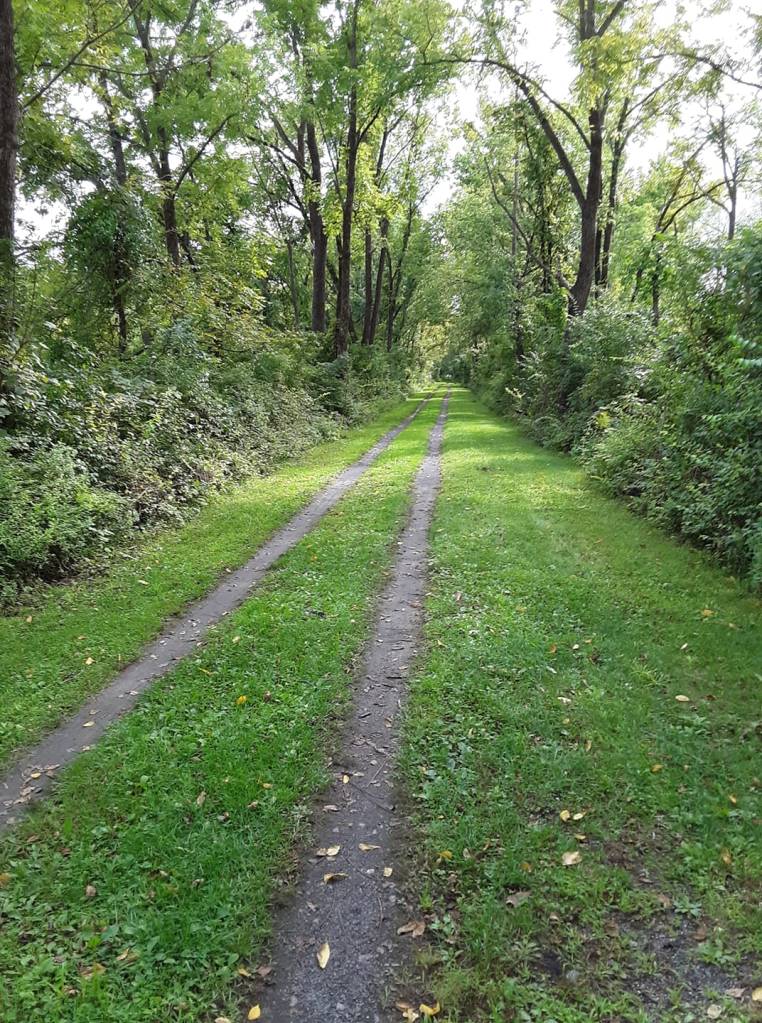
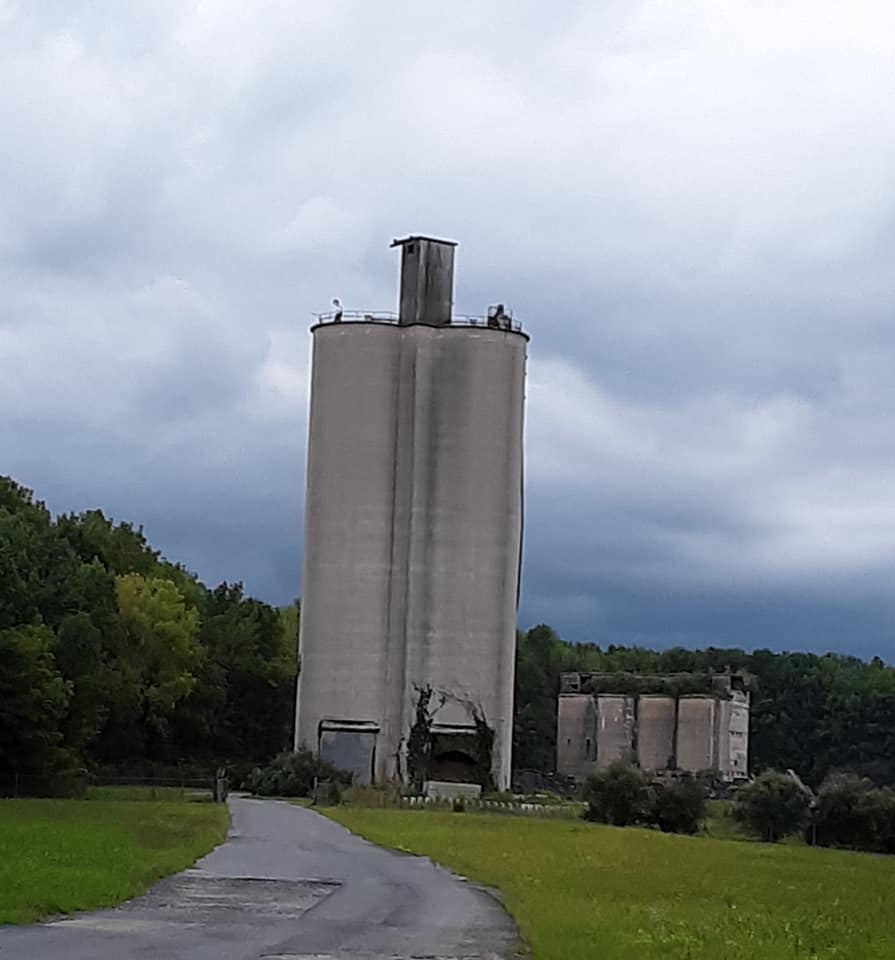
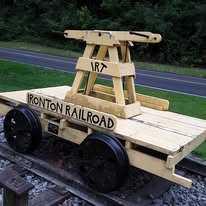
My name for the connected NorBath and Ironton trails is the “Cement Belt Trail” because both those old railroads serviced the cement industry in the Lehigh Valley. Here are a couple of views: near the east end of the NorBath, a relic of the cement industry, and a handcart along the Ironton Trail.
The Saucon Rail Trail/The Upper Bucks Trail —
There’s also the combined Saucon Rail Trail and Upper Bucks Trail, which together run about 12 miles.
https://www.montgomerycountypa.gov/DocumentCenter/View/3458/Perkiomen-Trail-Brochure-June-2024
Before the connection was made, the Saucon trail was only about 7 miles long. It is also wide, well-groomed, and runs for several miles through affluent neighborhoods in the affluent Lower Saucon Township. The scenery is OK, especially where the trail skirts the championship Saucon Valley Country Club golf course, but the trail can be a little too crowded for me sometimes. The development of the Upper Bucks Trail, short though it is, allows for about a 20-mile ride, round-trip, with the few miles on the UBT offering more rural and woodsy scenery.
The Perkiomen Trail —
https://www.montgomerycountypa.gov/DocumentCenter/View/3458/Perkiomen-Trail-Brochure-June-2024
The “Perky” is an interesting and challenging trail. Going southward, it follows the Perkiomen Creek through Montgomery Co., from Green Lane Park to a place called Oaks, where it connects to the Schuylkill River Trail. That trail goes on down to the Art Museum in Philadelphia. The Perkiomen Trail passes the site of the Philadelphia Folk Festival near Schwenksville, goes beside the grounds of Graterford State Penitentiary, runs through the town of Collegeville, and includes the hyper-challenging Spring Mount Hill. A sign at the bottom of the hill on the north side warns, “12 percent grade; 1/4 mile.” When I was younger, I sometimes succeeded in climbing it; some other times, I had to dismount and push. Lately, when I think about driving to that trail for a ride, I hesitate to follow through because I know I won’t be able to make that climb.
Trailheads and trail scenery
As I age (now closing in on 80), of course I am weaker all the way around. By some lights, I should be riding a recumbent bike or a motor-assisted one. Not yet, if ever. Without buying a trailer hitch for my car and a rear carrier, I couldn’t manage toting a bike like one of those to the trail. For the moment, I say I will never ride a power-assisted bike, even though two cyclists I respect have them. But as long as I can mount, pedal, and dismount my 26″ Cannondale I’m staying with it. Snob confession: whenever I see someone on the trail riding a power bike, I try to ignore them (although I do mutter “ride a real bike!” under my breath.) OK, those kinds of bikes do allow people who might not otherwise be biking to get out in nature and ride. That’s a good thing. But the trails I ride are mostly level, and the occasional climb is manageable, if not easy, on my leg-propelled bike. I don’t have to go 20 mph to have fun, and even if I did, there would be the expense of buying a new carrying rig for my car. I’ll die first.
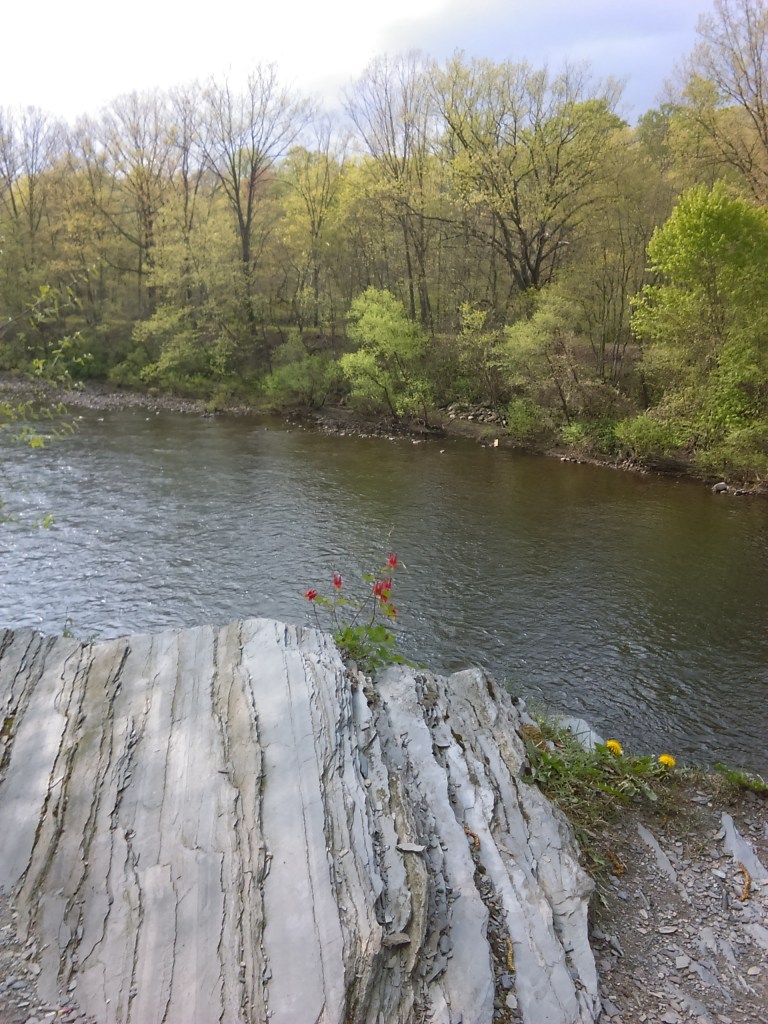
I won’t get into a long discourse on “act-suffer-learn” in this sidebar, but I will say that paradigm is instantiated every time I go out for a ride — even if it’s peaceful and without incident. It has to be, because to go for a ride is to act, and whatever happens on the ride is some kind of suffering (sweating, shortness of breath, falling, or any kind of discomfort). Learning is variable; maybe it’s just making a mental note of hazards on the trail or appreciating the natural beauty through which I ride — like finding this nice little rock outcropping above the Lehigh River:
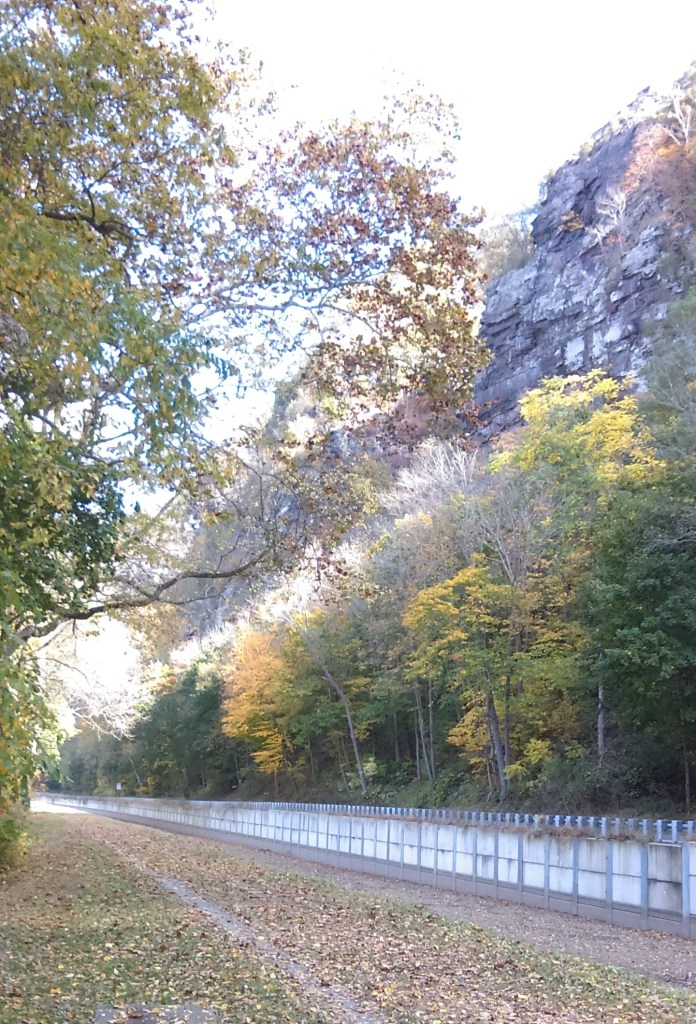
Or riding past the Nockamixon Cliffs along the Delaware River on a fall day:
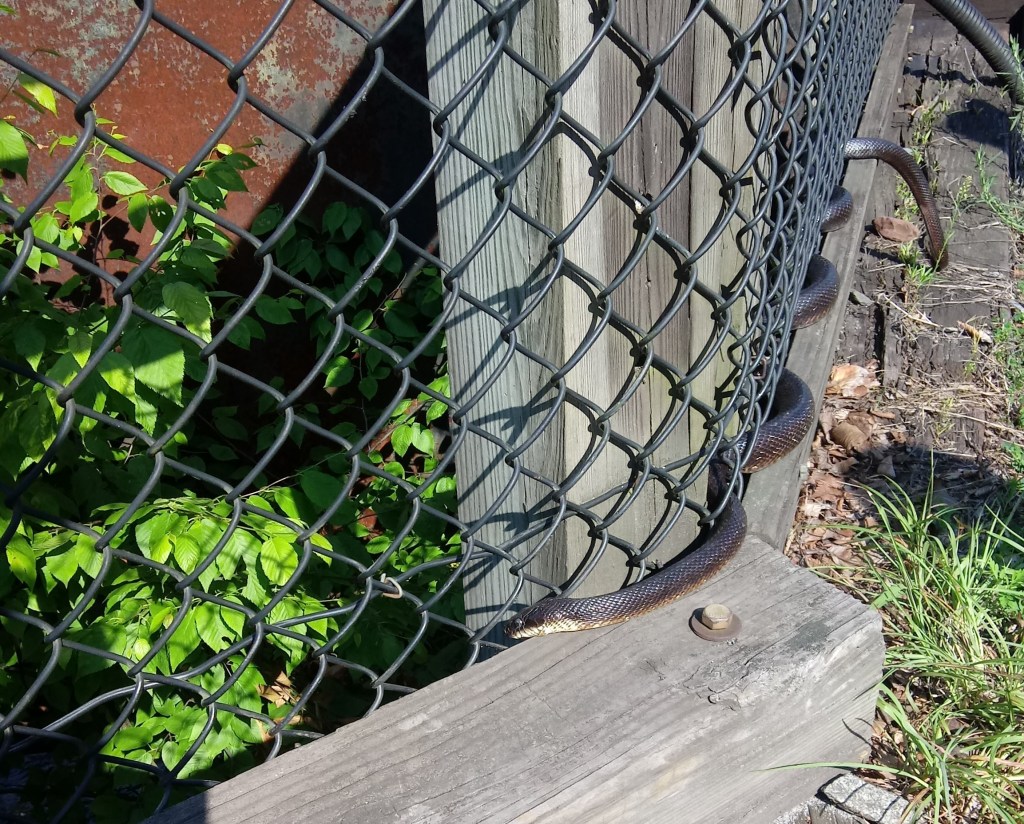
Or coming across animals in their own environment. At a place in the Lehigh Gorge known as Penn Haven Junction, I found this handsome black snake slaloming through the links of a fence as a way to shed its skin. Yo!
Big Blue Herons are among the fabulous birds I’ve seen along the trail. This one was checking out the Delaware Canal at low water.
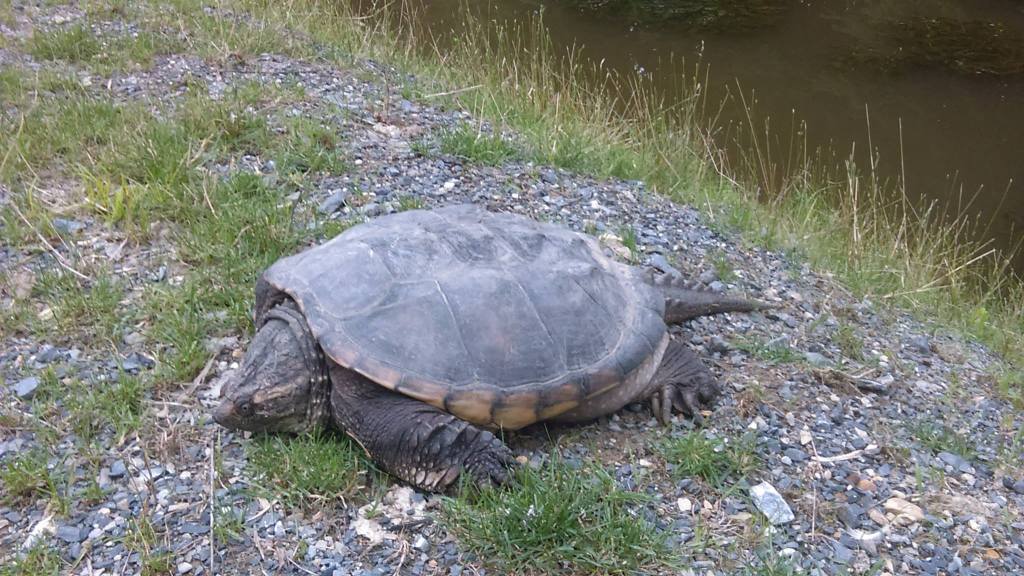
And the occasional snapping turtle looks like it just crawled out from pre-history!
Long as it is and close to my home, the D&L, or some portion of it, is my go-to trail. Here’s a short clip I made riding through the woods beside the Lehigh River on an autumn day and stopping at a little rest spot. Maybe you can get an idea of how nice it is:
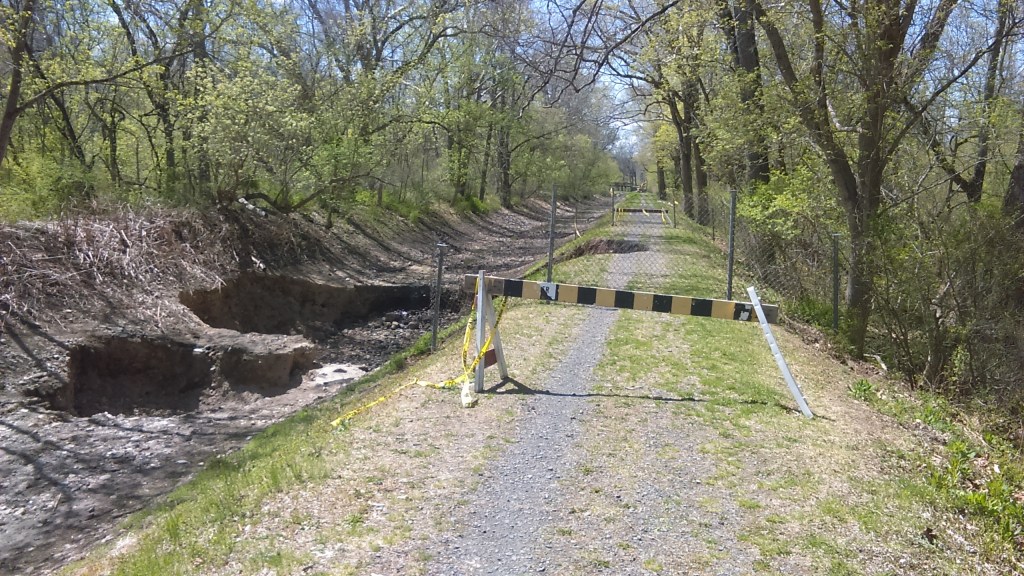
Most of the trail along the Delaware runs atop a levee that separates the canal from the river. Being a century old, though, the levee is fragile. At the moment, there are enough breaches in it that the canal has been drained until the repairs are finished. The scene below is of a breach caused by water rushing through an early 19th-century culvert that burst and compromised the levee. The breach is visible between the barricades. When the canal is full, this is ride is even better. Perhaps by next season it will be.
Most of my rides are done in shuttle fashion: out and back. But there is a loop ride I like. It’s about 23 miles roundtrip from the wonderfully named town of Upper Black Eddy on the Delaware down the Pennsylvania side to Lumberville, where a pedestrian bridge crosses the river to Bull Island State Park in New Jersey and up the Jersey side to Frenchtown, where there’s a road bridge back to PA.
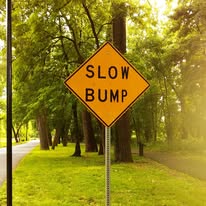
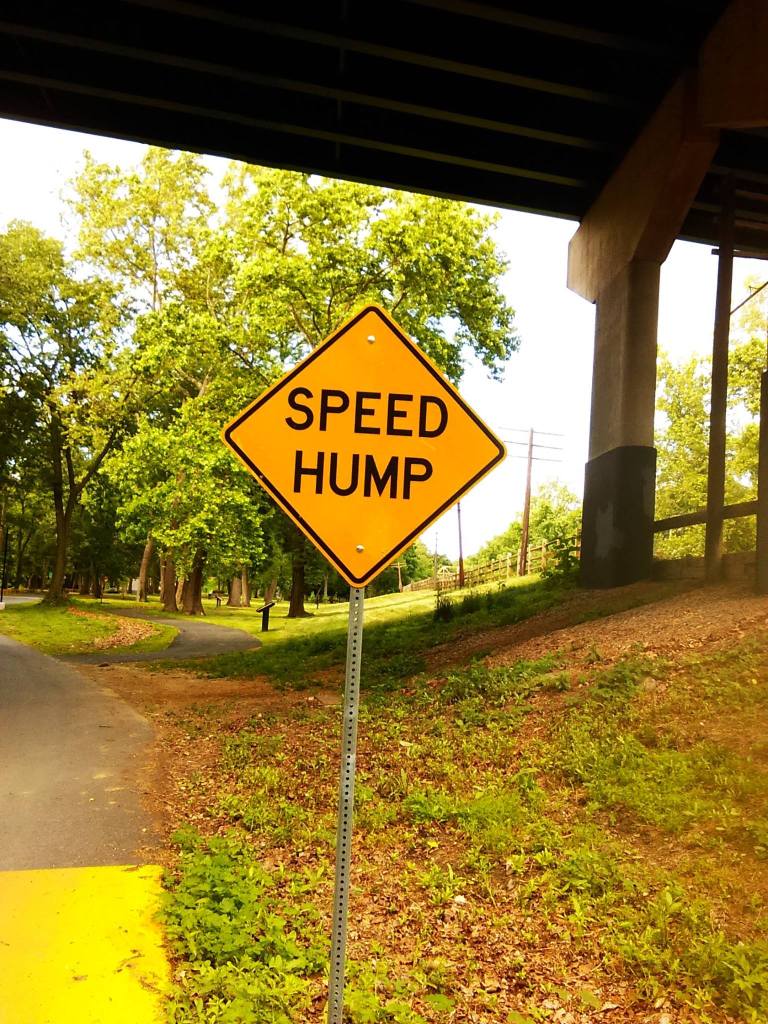
For years, I interpreted the term “trailhead” to mean the end point of whatever trail; I called places along a trail where you can get on “access points.” Eventually, I’ve learned to call any point of access to a trail a trailhead, which is the common sense of the word even if metaphorically wrong. So every trail is a multi-headed beast, and you start your ride wherever is convenient. My favorite trailhead for the long D&L is at Hugh Moore Park in Easton. When I first started trail riding earlier in this century, the park was pretty derelict, but — and I am assuming here — the federal grant that created the “Delaware and Lehigh National Heritage Corridor” enabled not only improvements to the trail but the spiffing up of Hugh Moore Park. In any case, it’s a good starting point for a ride: from there I can ride across the Lehigh on a road bridge with a dedicated bike lane and continue on westward/northward along the Lehigh Canal Trail portion or I can stay on the south bank of the river and take it to downtown Easton where the Lehigh flows into the Delaware. For a little fun with rhetoric, I invite a little foray into semiotics, the study of signs and there meaning. All kinds of signs, of course, but actual informational signs as well. In the photos below from Hugh Moore Park, we have two signifiers referring differently to the same signified. Alas one of the signs has now been replaced, so the fun confusion is no longer available — except in memory.
Incidents, accidents, and encounters
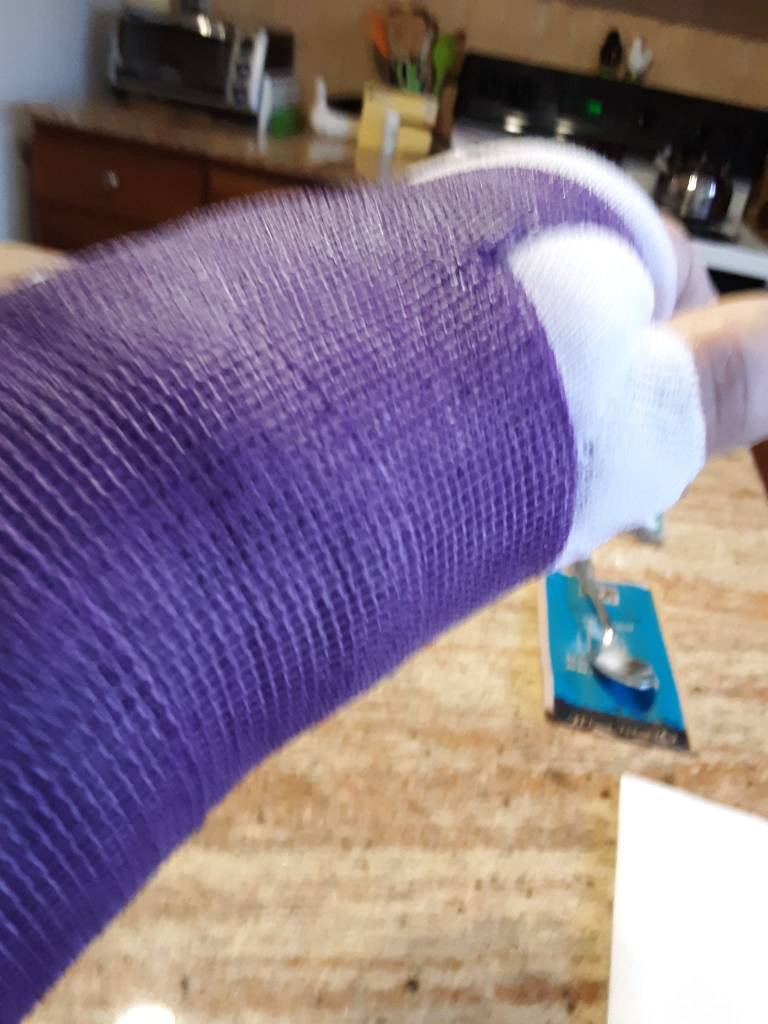
If you bike, you are going to fall. Maybe not every time out, but enough to make it a hazard. Of course I would never ride without a helmet, but in the past few years I have been taking blood thinners. So even a “light” fall can result in copious bleeding. When I first started on these, and told my cardiologist what I did for recreation, he said to me “Try not to fall,” as if otherwise I would. Yeah, right. The day before Thanksgiving in 2022, I went out for a ride on the Cement Belt Trail. I wasn’t looking for a long ride, just a shortie to cap off the year. As I was going through a gate at a road crossing, I fell, slowly and lightly, to my left. Couldn’t get my foot out of the toe clip fast enough to plant it on the ground, so over I went, catching my left wrist between my hip and the ground. I knew right away it was broken. In all the falls I’ve had — and some of them bad — I had never broken a bone. Thank you osteoporosis! Yes, that is my arm in that cast.
Along the Delaware Canal, there are spillways that allow excess water from the canal to flow into the river. Some of these have footbridges that give the user an option to dealing with water — when there is water in the canal, which is not a given.
Where the water leaves the canal, as in the video above, there’s a section of concrete on the trail. At one such place, where no footbridge is involved, it takes some derring-do to ride across it. Even though the water in the spillway is only a few inches deep, I developed a strategy to cross it without soaking my shoes and socks. I’d get up a head of steam and just before I hit the concrete section I’d lift my feet off the pedals and tuck them up behind me — which means I’d be freewheeling. This was thrilling and fun.
But Labor Day weekend 2020, riding my Giant, with had narrower tires than those on my Cannondale, the force of the water swept the bike out from under me. Down I went, splat! The water cushioned me from breaking a bone, but I landed on the bike and it beat me up a little on my left hand and leg.
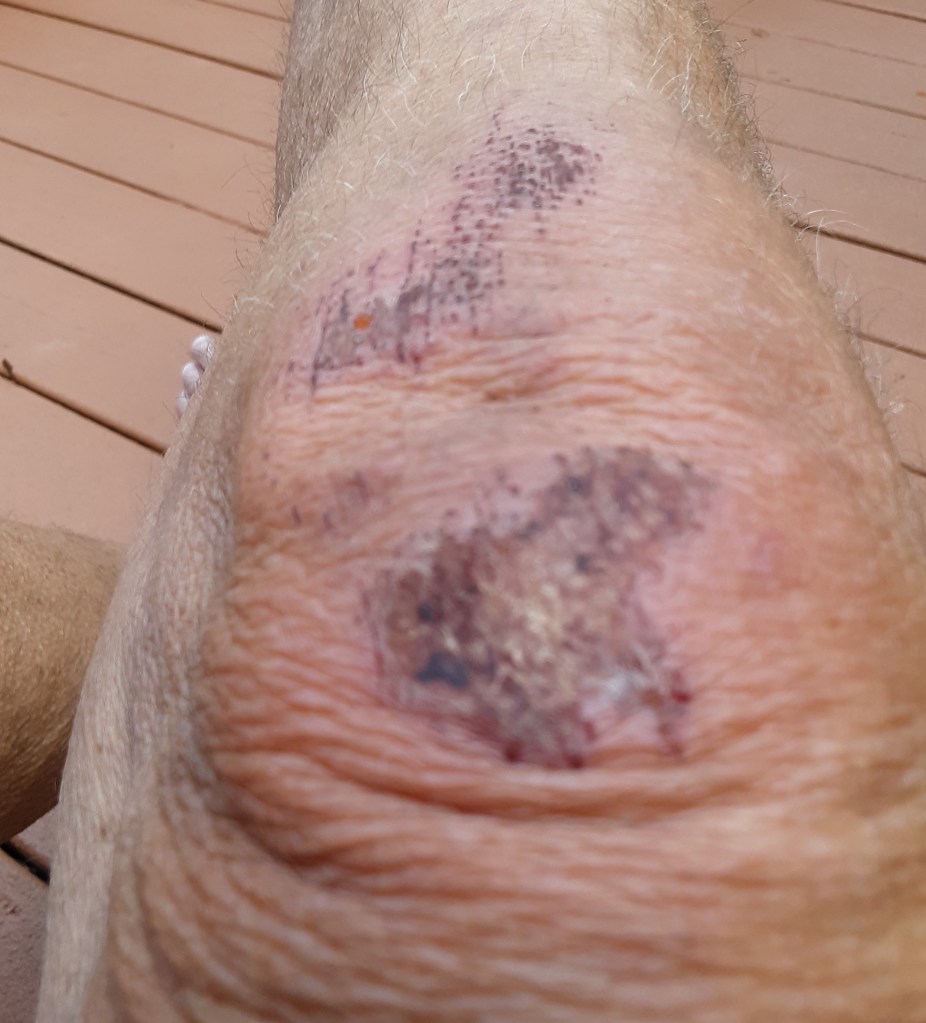
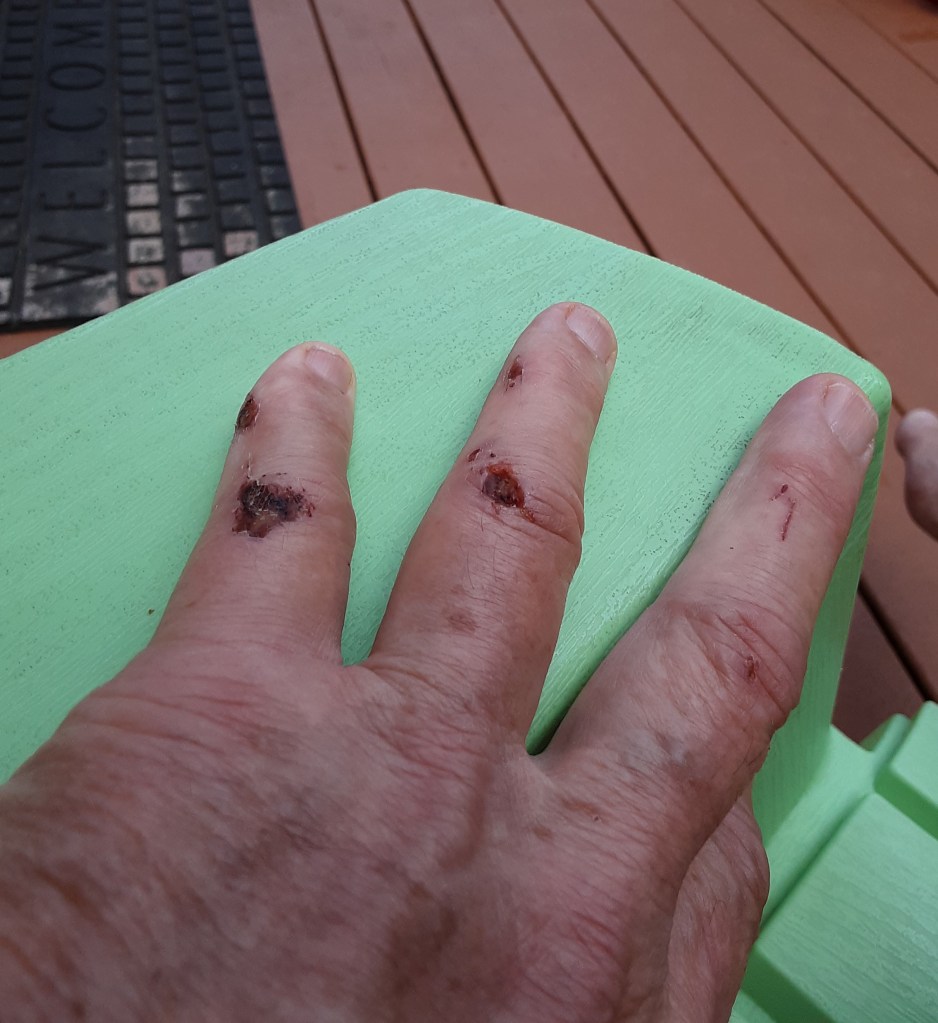
That too was thrilling, but definitely not fun!
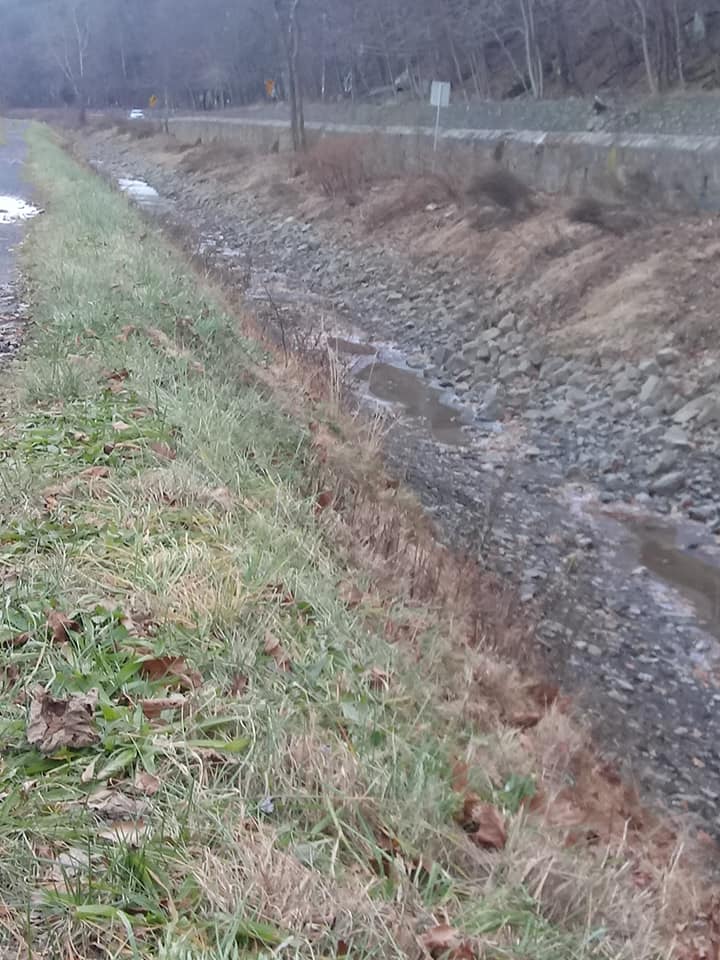
Another time: August 2018; it had been a rainy summer. There were puddles on the trail, especially in a stretch full of potholes. Zipping along heedless, I tried to skirt a puddle but caught the wet grass at the edge of the trail and fell down the canal bank into a couple of feet of water. With the help of some passersby, I dragged my bike up out of the canal. It was damaged, but my Bob Brien, my fave bike mechanic, saved it. He was most concerned that water had gotten inside the tubing, so the bike had to be disassembled and dried out. Successful, which earned Bob the title of “bike whisperer.” My cellphone, however, did not survive the dunking. Here’s a shot of the canal, dry, about where I went in. You can get an idea of how steep the banks are at this point.
Another fall — involving me only as a spectator — was in 2017 when, riding along the Lehigh near Easton, I saw a tow truck come down from the nearby road and disappear down the trail beside the river. That was a first. When I came upon the stopped truck I saw the driver’s objective: a car lying on its driver’s side just off the trail in the river. That was scary. The tow truck driver said a motorist unfamiliar with the area had been led off the road to the trail by his gps. The unlucky driver got as far as the road bridge that crosses the river from downtown Easton, where the overhead clearance is too low for even a small car to get through. So the driver reversed the car up the narrow trail to a slightly wider spot where they tried to turn around. Bad move: the car slipped off the bank and into the water. In this video, I am riding upriver from Easton, beneath the road bridge and along the narrow, if paved, trail. The spot where the video ends, just beyond where the wall slopes down to meet the trail, is about where the car fell into the river. The tow truck guy said the driver was able to climb out through the passenger side window and wade ashore. Good enough, but I hope I never see the like again.
Often I encounter other people, especially other cyclists, on the trail. Usually these meetings are routine, nothing to write home about. But not always. One time, riding along the D&L Trail east of Bethlehem, a cyclist passed me at a narrow spot, on the right, with no warning that he was there. He was really hustling and was quickly out of sight. After a couple of miles, though, I drew within view of him. I challenged myself to see if I could catch up with him. I wasn’t angry, just stimulated. I cranked the Giant up to about 15 mph and came up behind him at a point where the trail divides around a tree. He went left; I went right and with a bit more acceleration got in front of him. I rode maybe another half mile when I heard something to my rear and, thinking something had fallen, I braked. Disc brakes, remember. The other rider just about climbed my back, he was that close to me. He was cool, though, and said, “Hey, bro! What’s up?!” I explained why I’d stopped, and he launched into his biography. His name was Angel. He’d been a bike messenger in New York City and was riding the bike he’d used for that gig. He said he’d moved to Bethlehem and had an apartment in the “pre-historic district.” He showed me how his machine was geared in such a way that “You can’t catch this bike.” All right. Then he hopped back on his saddle and sped away. After another while, I came close to him again. I was just about to pass him and say “That’s twice!” when he stopped and smiled. “You want to get a beer?” he asked. “Sure,” I said, and we rode together to the bar in a seedy hotel in the worn-out nearby village of Freemansburg. He bought me a beer; I bought him one. Then he goes, “You want to smoke a blunt?” “Sure,” I said again. We left the bar and went on across the trail to a secluded spot by the river. He rolled one up and we toked on it. At this point, another dude appeared. He too was Latino and knew Angel. They discussed a fertile fishing spot nearby, then I thought it was time to move on. But Jose (as he called himself, stammering) told me that if I ever wanted some weed from the Marvine (public housing in Bethelehem, not far from Freemansburg), I should just ask for Jose, “the guy who talks funny.”
Thanksgiving weekend one year (2013?) was unseasonably mild, so I went on down to the Perkiomen Trail, feeling strong enough to challenge the notorious Spring Mount Hill. One of the tricky features of that climb is that you get about 100 yards up and think you’re doing well, when the trail bends and gets much steeper. I confess I’ve never figured out how to best run through the gears on that climb. This particular time, I was trying to shift to my lowest gear when the chain popped off the cassette and got wedged tight between the caassette and the crank on that side. Could not get it loose! But here’s something I’ve learned about some fellow trail-riders: if they see you broken down, they’ll stop and offer to help — most of the time. (I do the same, and I carry a few tools on my bike in case they’re needed.) So it’s getting late on a November afternoon, however mild, and I am in an out-of-the-way place. Another rider comes along and tries to pry the chain on my bike out of the vise it has got stuck in. It looks like he’s not going to succeed. I pick up my cell phone and call my wife. I’m going to have to beg her to drive to a place nearly an hour from home to which she’s never been so she can take me to my car, which I can then drive at least close to my stranded bike and carry it home. The whole project is fraught! But just as I’m starting to give her directions, the other cyclist pops the chain loose. I can reset it on the gear cassette and be on my way. I never did get his name.
More recently — Labor Day weekend of this year — I head up the D&L where the trail runs about nine miles from the Cementon trailhead to the small town of Slatington. This portion of trail is through woods along the Lehigh R., with very few access points. On this day, eighteen miles r/t will get me to 300 miles for the year — dinky but at least it’s a round number. I make it to the Slatington trailhead, take a break, eat my little snack and hop back in the saddle to ride the return leg. I go about five miles when I notice my front tire is going flat. That makes the bike hard to steer, and if I do try to continue riding, I’m afraid, I’m going to destroy the tire and wheel. It’s also hard to push the bike with a flat tire, so I have to tip the handlebar up and roll the bike along on the rear wheel. This probably sounds a lot easier than doing it is. But I’m trundling along, hikers and cyclists passing me in both directions. One group stops to offer help, but just at the moment when I am again calling my wife to drive up to the closest trailhead and ferry me to my car. So I have to wave these folks off. Other passersby cluck in sympathy or try to make jokes, but it’s all I can do to roll my bike along in this awkward position so that I can’t even respond to them. Then an old man (at least he looked older than me), long-haired, long-bearded, carrying a staff while he walks north stops to offer help. He’s so earnest that I have to give him some response, part one of which is “I don’t know what you could do,” and part two is “It’s taking all my stamina to push this bike; I don’t have the strength to even talk with you!” So he goes on his way and I go on mine. A bit later, he has turned around and approaches me from behind. He practically begs me to let him help. The only thing I can think of is to detach the front wheel and let him carry it while I continue the one-wheeled push I’ve been doing. This does help, because now there’s less weight on the front of my bike. Also, at this point I’m less than a mile from where my wife is waiting. She’s there, I lock my bike to a railing at the parking area, and get in her car to ride to mine, another four miles down the line. It all works out OK eventually and I return home fatigued and dirty. The old man, “Paul,” he said his name was, may have offered more moral support than physical, but he did offer, showing there are indeed some Samaritans out there.
 Rhetorman