“Gimme a head with hair!”
In 1969, I enlisted in the U.S. Navy. I was 23 years old, a college graduate, and had started a Master’s degree. The draft hung heavy over every young American male in those days. I was afraid of being drafted and sent to Viet Nam. Upon graduation from college, I was reclassified from “student” status to “draft-eligible.” My stint in grad school was, in part, a move to at least delay my inevitable military service.
That move was successful for a while, but I got my “Greetings” letter in December 1968. Merry Christmas! My local draft board did let me finish my semester at grad school, which ended in January 1969. I was told to report for induction into the Army in mid-February. I rolled the dice and signed up for the Navy instead, trading two years in the service for four but probably keeping my young ass safe until I could get out. (Note: I have no photographic evidence of any of this; I despised the Navy so much that after my release I destroyed any pictures I had. Please don’t be disappointed!)
I told my dad I would try to make the best of it, but the Navy sucked from the start. My antipathy was not political, although it became that later. It was more that I was having to do something I did not want to do, to give my time where I didn’t want to give it. It was a daily, near-constant assault on my sensibility.
After six months post-boot-camp at Great Lakes Naval Training Center, where I was with a group of college grads awaitng word on our Officer Candidate School applications, I was assigned to the aircraft carrier USS Forrestal, homeported in Norfolk, Va. I reported in October 1969. Here is a shot of it when it was still in active service. (It has since been sold for scrap and sunk as part of an artificial reef off the Atlantic coast of Florida. At least now it’s not hurting anyone.)
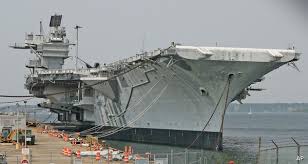
The ship went by several unofficial nicknames when I served aboard it — the “USS Forest Fire” or the “USS Zippo” — because it had had a horrific fire in the Gulf of Tonkin in 1967. More than 130 crewmen were killed and another 160-odd injured. Word aboard ship when I arrived was its crew was safe from being deployed to Viet Nam because it was in Vietnamese waters that the fire had occurred. This link takes you to an account of the Forrestal fire. https://w.wiki/7k6R
So the Forrestal was assigned to the Sixth Fleet, which covered the Mediterranean. I made two six-month cruises to the Med. After the second, in the summer of 1971, the Forrestal went into drydock for a major overhaul. That was supposed to last a year, and during that time no one could live aboard the ship. My young wife and I found an apartment in the area and tried to live the usual kind of American life. That worked, for a few months. Then word came down that the refurbishment of the ship would be speeded up so that it could make another Med cruise in early 1972. I thought I would lose my mind.
To back up a bit, the group of guys in “OCS Hold” at GLNTS was a congenial bunch that formed a network of college-graduate enlisted men, none of whom really wanted to be there. Among them was Dennis D’Andrea, one of the best people I have ever known and certainly the best shipmate I served with. By the time he was reassigned from GLNTS, Dennis was a Petty Officer, so he landed a shore duty assignment at Guantanamo Bay Naval Station. Like Dennis, I had taken the exam to earn the speciality designation of Journalist, but my score wasn’t high enough to boost me to PO3. I was JOSN. When my turn to join the fleet came around, I was assigned to the Public Affairs Office on the Forrestal. Suck City, but at least I wouldn’t be swabbing decks or standing watch. It could have been worse, but that didn’t make me happy.
It was, however, my luck in late 1971 to have Dennis, who was now at a shore duty assignment at the Norfolk Naval Station, tip me to a billet (or a “job”) in the same office he worked at, that of the Commander in Chief, Atlantic Fleet. I was to report there in January 1972, with about a year left in my enlistment.
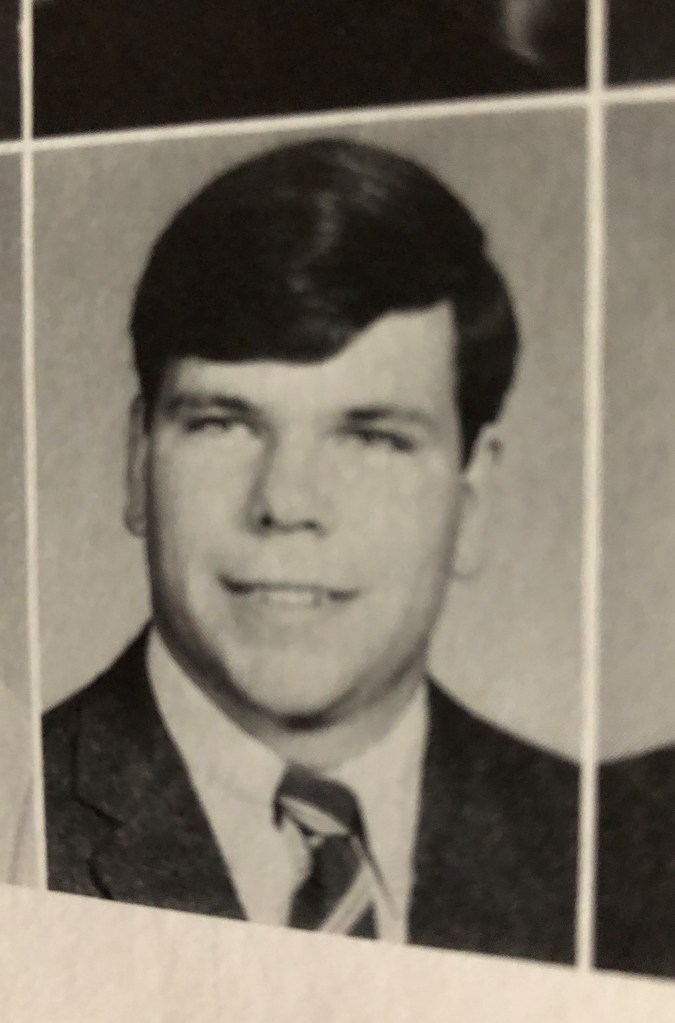
I left the Forrestal on transfer leave shortly before Christmas, 1971. Between the holidays and the transfer leave, I had let my hair grow long — not real long, not “shoulder length or longer” — but far too long for Navy regulations. The picture below shows me as a college student, c. 1968. My hair is by no means long, but maybe it gives an idea of what I looked like as a young man.
In late 1971, I was digging going about in civvies with hair that made me look like just another hip young dude. You have to understand: long hair was an important statement for guys my age; it conferred identity, just as a military haircut did. And any hairstyle is, of course, rhetorical.
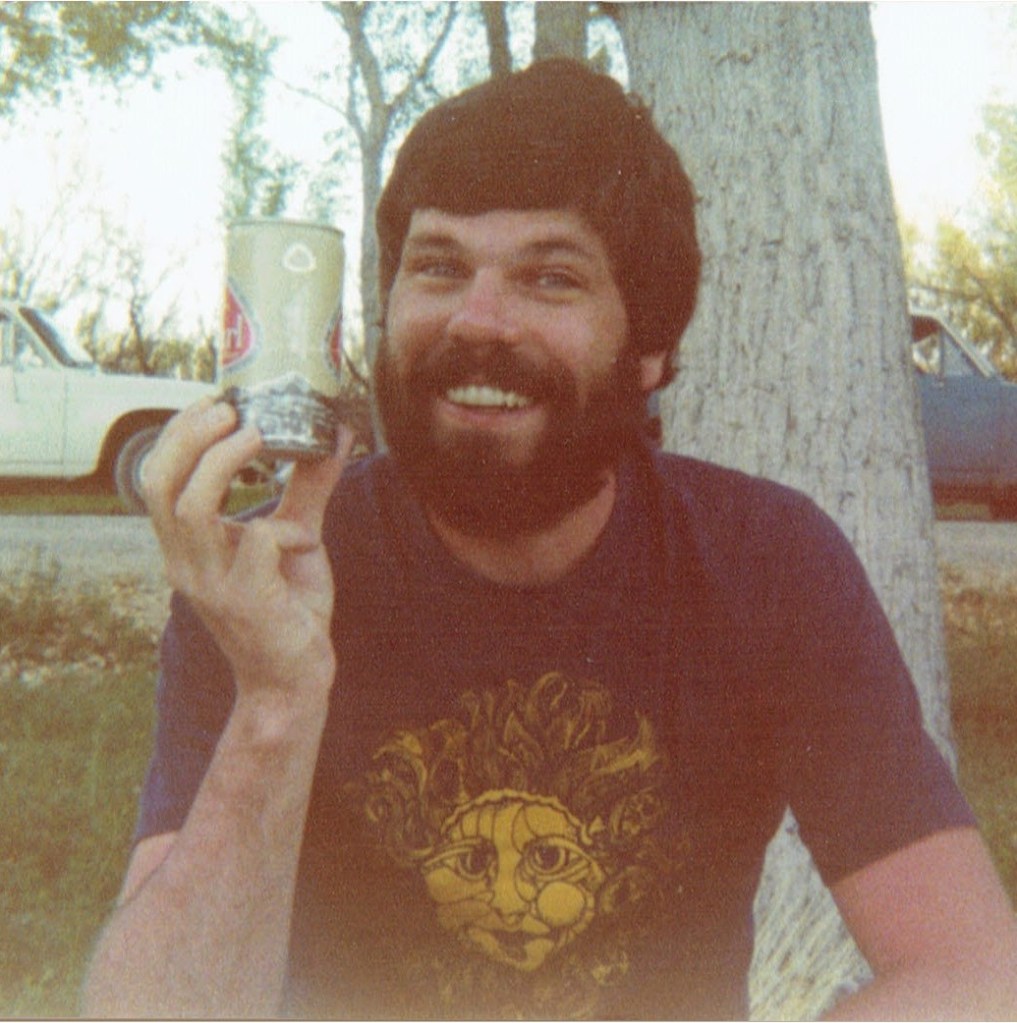
Living in the military-soaked area of Hampton Roads, Va., it was smooth to not be seen as a sailor or, worse, a Marine. Plus we had a snazzy little Porsche 914 that I loved driving with the top down and my hair flowing. The picture below was made in the late 1970s, probably five years after my discharge from the Navy. I have no photographic evidence of my life earlier than that, but this one shows my hair about the length I wore it in 1972.
It occurred to me that no one at CinCLantFlt HQ (except my buddy Dennis) had ever seen me before. No pictures, either. They only knew that PO3 Wingard was reporting for duty in the Public Affairs Office in January. I had a bold idea that I thought was worth the expense and the risk: I bought a wig and had a hairdresser cut it short, not military short, but shorter than what it was. I showed up for duty wearing it. I’d pin my long hair up and slip the wig over it. No one was the wiser. The office being mostly men, no one suspected that my hair was phony. Also, the enforcement of regulations was looser there than it had been on the ship, so even if my “hair” was a little too long by Navy standards, no one hassled me about it. This is not me in the picture below, but the image is the closest I could find to me in my short-hair wig, c. 1972. Looks pretty realistic, don’t it?

Navy life became almost tolerable: I lived off base with my wife and cat. Drove to the base every morning in my uniform and wig and drove home every evening to our apartment and assumed the identity of a young hippie. It was cool. We moved to a nicer apartment near to my wife’s job in Portsmouth, Va. That city was the site of the Naval Shipyard where the Forrestal had been dry-docked, but it wasn’t teeming with sailors like Norfolk or Virginia Beach. Dennis got out of the Navy before I did and took a job at a newspaper in Elizabeth City, N.C., which was the closest place of any size south of the Great Dismal Swamp. Carolyn Murphy (my wife) and I would drive down to E.C. on summer weekends and go with Dennis to the beaches on the Outer Banks. I was as happy as I could be under the circumstances. There was never a problem, even though on hot summer days my wig would slip and I’d have to adjust it. But as long as no one suspected, I was good.
There was just one tense moment: to everyone’s surprise, an inspection was called some time in the fall of ’72. This gave me a challenge. For one thing, I had grown out my mustache so that the ends of it went below the corners of my mouth, counter to Navy regs. Easily enough solved by my growing out the rest of my beard to hide my unsat mustache. The wig was another issue. Rather than get a haircut, though, I bought the biggest sailor hat I could find — like a size 8 — and stuck it on my head to stand inspection. I guessed rightly that the Admiral wouldn’t be picky; that the inspection was just a formality. I may have quaked a bit in my shoes when he came down the line to where I was. I may have worried that he would say, “Sailor, uncover” and see that my hair was not really my own. But he did not; he just passed on by nodding at all the spiffed-up sailors.
Until now, no one except Carolyn Murphy and Dennis D’Andrea knew my subversive secret. I don’t mean to brag about outsmarting the Navy. Yes, it was my choice to wig-up, but the absence from the imaginative repertoire of anyone who saw me of the idea of a sailor wearing a wig worked in my favor. That ignorance was my bliss.
 Rhetorman