Of course I’m writing after having returned. The USA sucks, and that is more evident when you see another way of doing a nation, i.e. Canada. If it weren’t so cold and dark in winter and if I weren’t 80 years old, I’d pack up and move there. Mainly if I weren’t 80. Bob Kelly, a guy who was my roommate for a year in grad school and a friend then and now, has built a house on Price Edward Island. I suppose it’s a summer retreat for Bob and his Nova Scotia-born wife, Heather, from their American home in Macon, Ga. But I see it as an escape hatch, and I envy them that.
In October, 2025, my wife, Karla Morales, and I drove to Quebec for a short visit. Doing so gave us the chance to visit sister-in-law Linda Ringeisen, the widow of my brother Alan (see elsewhere on this site) in Mid-Coast Maine. We hadn’t seen her since 2021, when Alan was still alive.
That trip and visit inspired us to try something similar this fall. Instead of Quebec, we chose to visit one or more of the Atlantic Provinces. We booked a night in St. Martin, New Brunswick, right on the Bay of Fundy, then two more in Shediac, out beyond Moncton to the east. At the b&b in St. Martin, the host talked up the Fundy Trail, marking tips on the brochure. We were keen to see the famous, rugged shoreline on the N.B. side. In addition to the modcon of gps-guided travel, we lugged along a road atlas. From it we’d identified Fundy National Park as a place we wanted to visit. Leaving St. Martin, we plugged FNP into the routing software and set off.
Our mistake was conflating the National Park and the Trail, which is a Provincial park. Starting near the western end of the Trail, we drove all around it into the Park. And didn’t realize our mistake until we check the paper map and saw that we were in the village of Alma, on the eastern end of the Park. We did subsequently drive through the Trail, but east-to-west, winding up back in St. Martin! This was pretty much my fault, and I felt a little like we’d let down Keith, the b&b host who was so enthusiastic in his advice.
Here is a link to the Trail:
https://tourismnewbrunswick.ca/fundy-coastal-drive
And here is one to the Park:
https://tourismnewbrunswick.ca/fundy-coast-road-trip
Keith, it turns out, was an evangelical Christian. He didn’t tell us that directly, but there were signs. Of course his cheerful demeanor could have suited anyone in his role, but I came to interpret it as part of his religiosity. Other born-agains I’ve known have been relentlessly positive. He told us that he was American and his wife, Canadian; he was applying for dual citizenship. They had a home in Florida, where his wife was at the moment. He had recently returned to oversee the last couple of weeks of the b&b’s open period. I was ready to sympathize with the long drive, but he gave no complaint about the road mileage between Florida and New Brunswick. When he learned we were from Pennsylvania, he raved about visiting Lancaster, especially a theater there that I’d heard about from my B-A-C brother, Jan, also raving. Clue #1. Then he told us he was a professor at a college in Florida, conducting classes long-distance on the Web. I asked what college. “Palm Beach Atlantic University,” he said, and went on to say that even though college enrollments were down everywhere, PBAU was robust and had just admitted their largest incoming class. Clue #2. His enthusiasm tamped down my inclination to sympathize with what I knew to be the higher education climate in de Santis-led Florida. When I later looked up PBAU, I saw that it was a “Christian” institution. Their current fund-raising campaign goes under the heading “God-Sized Dreams.” So Keith couldn’t see or hear, much less speak, any evil. All the same, his touting the Fundy Trail was appreciated. Too bad we didn’t clarify Trail and Park.
Brief aside: we had some Canadian bills that we dug out of storage for the trip. In St. Martin, we went to a convenience store to buy some beer. Thought it would be a good time to flash our Canadian currency. The Thai man running the store commented on the funny color of the money. “Old-fashioned,” he said, and showed us current bills (actually made of plastic, not paper).
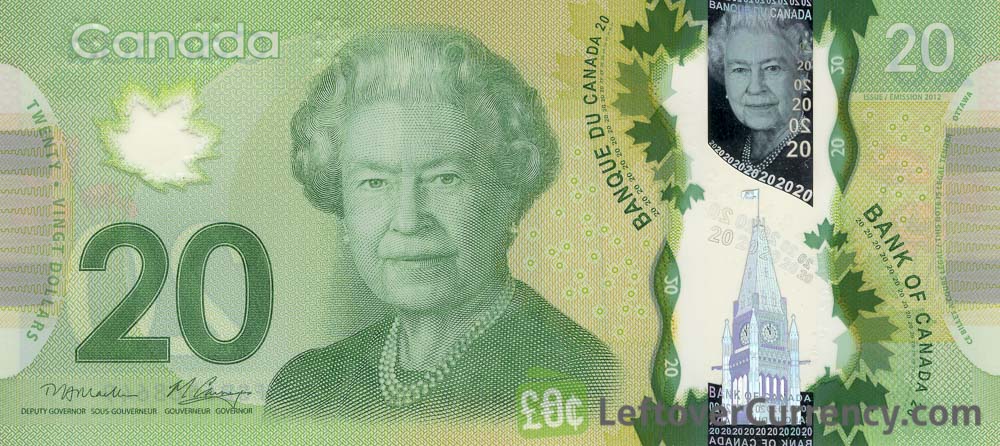
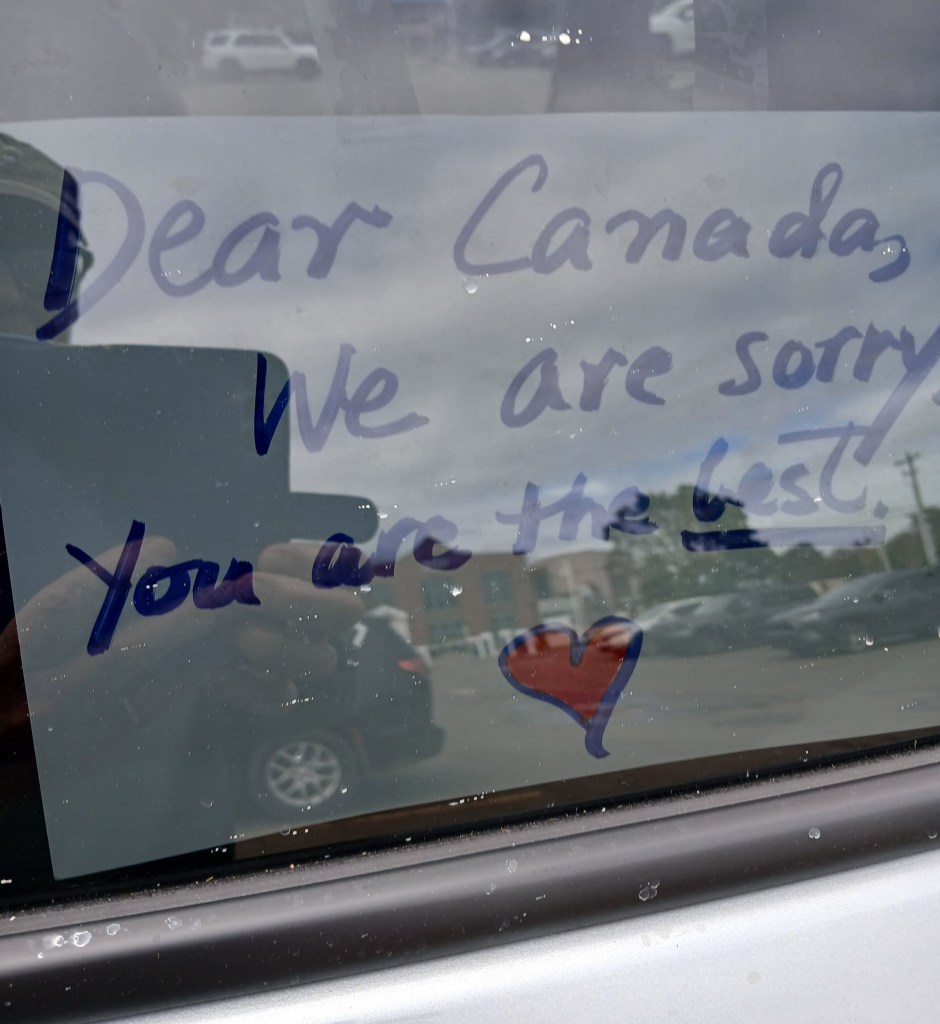
He was kind enough to take all our old bills saying he could change them at the bank. The next day, as we were at the toll booth entering the Fundy Trail, the staffer noticed the sign we had put in the back window of our car. It read “Dear Canada. We are sorry. You are the best!” All in blue with red filling in a heart. Her colleague from the other both came over and they both chuckled. The fee to enter the Trail was $27 Canadian. We had $25 in new bills. We moaned that we had no ones (coins now, no longer bills). She said, “I’ll spot you the two.” And off we drove.
The first stop along our re-routed tour of the Fundy Trail was near the Walton Glen Gorge. You could take a short (1.6 km) walk to a viewing platform to see a waterfall in the gorge. KM wasn’t up for the walk, but I slipped on my hikers and went for it. Alas, the gorge was full of clouds and I could barely make out the falls.
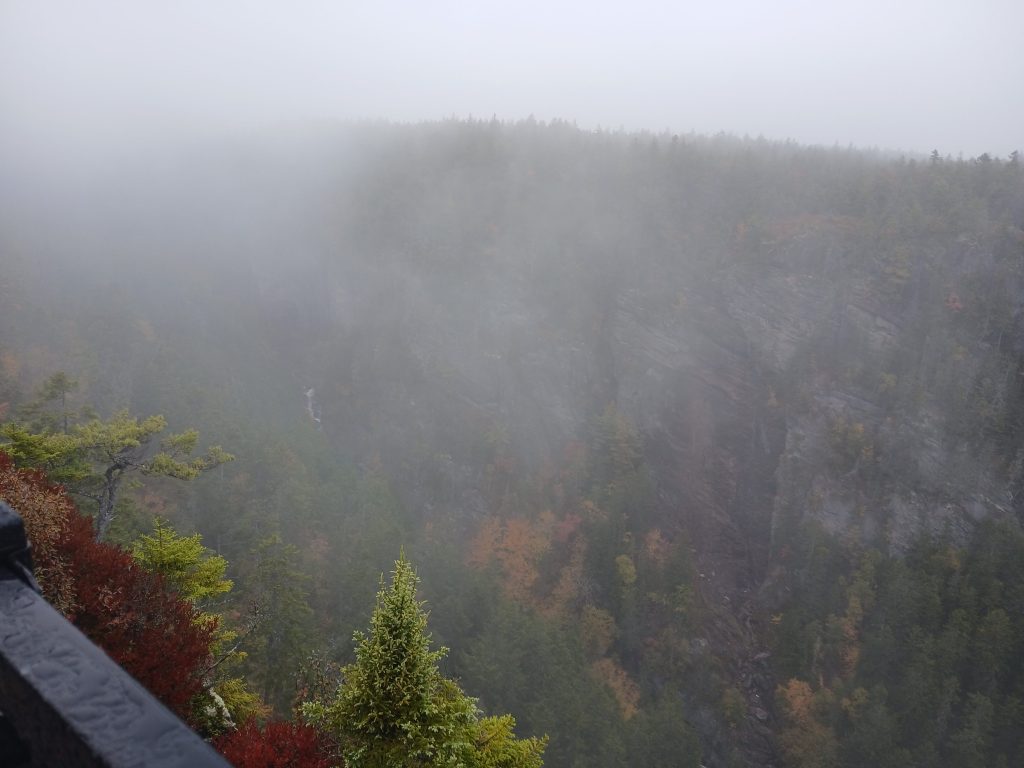
As I headed back, a rain shower erupted and I got pretty wet. Ha ha. We drove on for the rest of the Trail, but didn’t get out of the car for sight-seeing. Too bad, because the views out over the bay seemed to be spectacular. A cup of tea and some molasses cookies sustained us at the Trail’s only eating spot, where we got to see a video that included some time-lapse shots of the Bay’s famous tidal run. In real life, it was strange to see boats — big fishing boats — “aground” in a harbor, waiting for the rising tide to float them.
In Shediac, we stayed two nights at a nice small hotel. The first night was after our arrival from St. Martin. We went to a brew pub for dinner. The next morning, KM suggested we splurge on breakfast in the hotel restaurant. Who should be our server but the same young woman who served us the night before at the brew pub? Her name was Maggie. She was a recent college graduate; like many of her American counterparts, she was working (at least) two service jobs. That was not what she trained for, having majored in “Translations.” On that note, being in a bi-lingual province like New Brunswick was cool. People’s ability to switch between English and French just like that was admirable. Made me wish my own French weren’t so rusty. I can read it a little bit, and can utter the odd word or phrase, but that’s about it. Anyway, we told Maggie that we were undecided between driving over to Prince Edward Island or staying in N.B. and visiting Kouchibouguac National Park, reputed to have the warmest beaches north of Virginia. Since we hadn’t brought swim suits, that wasn’t really a draw. Maggie was non-committal at first, but then she pointed out that the day was young and a weekday. Even though a fierce wind had come up, she thought a visit to at least Charlottetown, PEI, was in order, if not a tour of the whole island. We took her advice and drove over there.
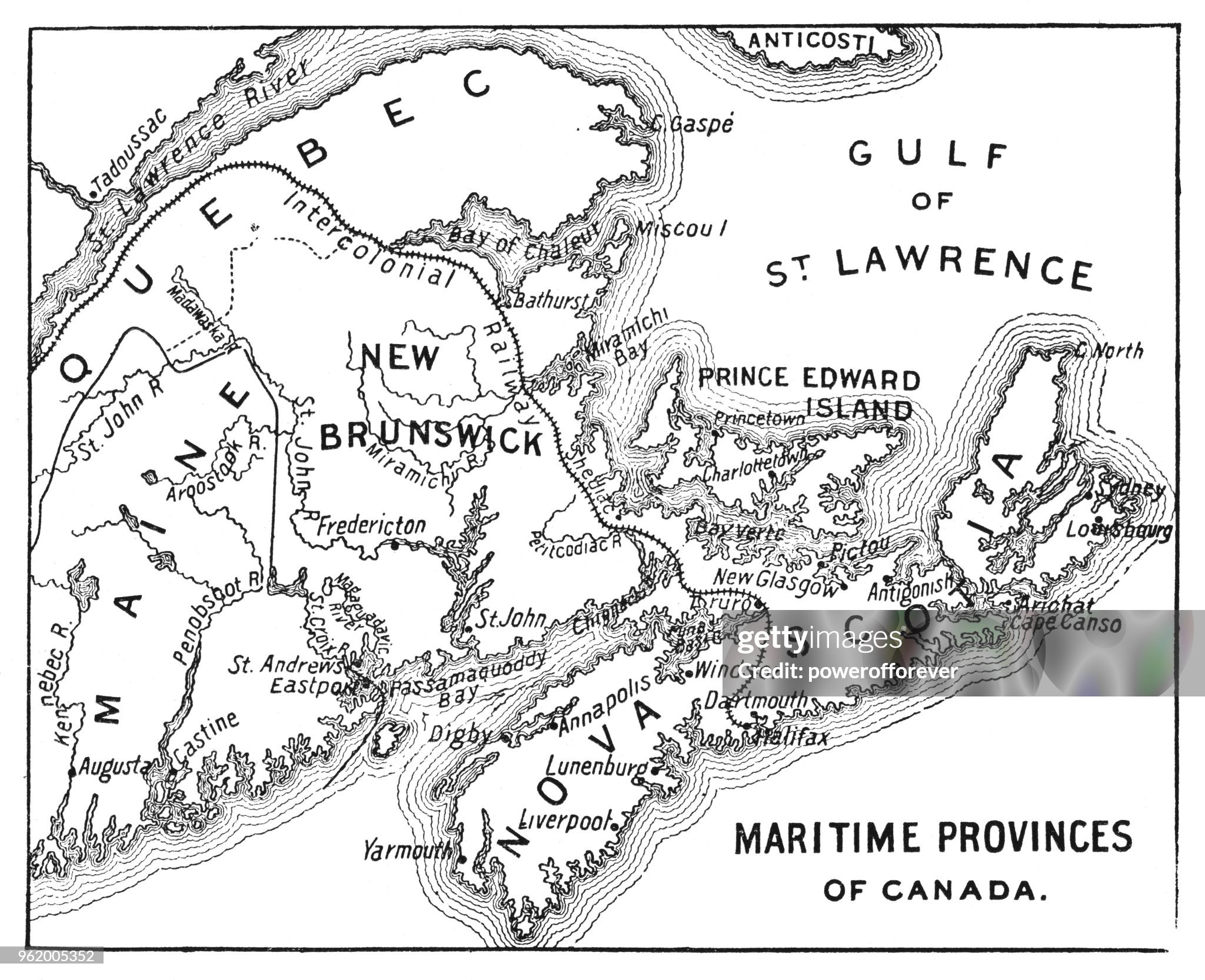
Although it was windy and consequently chilly, we walked around the center of Charlottetown for an hour or so. Visited the beautiful St. Dunstan’s Cathedral, the memorial to Irish immigrants, and a food court. Also had a cup of tea in a place whose feel was decidedly Euro. Certainly the spoken French in the air contributed to that. It was nice to feel internationality for a change. Yes, we can get a touch of that in New York City, which is just a 90-minute bus ride from home, but this was better. Charlottetown seems like a good place to live. As we drove back across the Hillsborough Bay to N.B. I realized a nice feeling that happens when you go out to some place you’ve not been before: that you are in some small way not the person who went out there; you come back different. This recognition may be understood as a function of the “Act-Suffer-Learn” paradigm of rhetorical travel.
The next day we headed back to Maine. Some thoughts on crossing the border back to the U.S.: The guard was straightfaced and serious. There was to be no verbal jousting with him, it was plain to see, but his presentation was like that of, say, a b&b host you might meet. His questioning seemed casual, interested in us, not just acting in his formal capacity. Later, though, Karla and I had some fun later mocking the interaction, as in:
Border guard: Where did you go in Canada?
Us: That’s our business!
Border guard: What did you do there?
Us: Uh, we looked around, saw some sights.
Border guard: How long did you stay?
Us: Long enough.
Overall, a visit to Canada shows how a country can be “civilized” and “modern” without the people being obviously stressed out and throwing attitude out constantly. For instance, you don’t see bumper stickers in Canada; people aren’t using their vehicles to make a statement. (Of course we rhetoricized our car for the trip with the sign shown above.) As well, their rhetoric of driving is to be careful and polite, not to act like they are the whole world in miniature. Like Americans do.
We’d like to go back!

